Showing posts with label web conversion. Show all posts

Friday, 5 February 2016

Measuring Content Performance for Higher Sales Conversions

In the Mad Men era, marketing was considered a cost center where “creative types” made glorious advertising campaigns but had very little ability to measure their impact on sales. Now, thanks to the Internet, marketing automation, and marketing analytics solutions, we can measure nearly everything in marketing, tracing our impact all the way down to influence on revenue and ROI. This ability to measure marketing’s performance and receive instant feedback on what works has revolutionized marketing.
Analytics are the key to performance optimization. Real-time feedback on what is working empowers us to improve message quality, creative, channel and offers to quickly improve the outcome. Without accurate performance analytics, we’d be back in the Mad Men era of creating content and launching campaigns into a black hole with no idea if they worked.
And yet, that is exactly the scenario in which most organizations find themselves today when it comes to content—no ability to measure whether their content has any impact at all.
Most marketers and sales enablement professionals (research shows greater than 85%) have no ability to objectively measure whether sales reps are using their content, how often it is being used, how effectively the content engages the customer, which customers, and whether the content has any impact on sales. Without this feedback loop, these content publishers lack the technology and processes to systematically optimize content.
Why is it, that a practice we consider de rigueur in top-of-the-funnel (ToFu) lead generation marketing has not been adopted in bottom-of-the-funnel (BoFu) analysis?
Well, ‘best-in-class’ organizations have figured out that closed-loop sales enablement is the answer and are seeing incredible gains from it including 3x higher revenue growth and 50% greater sales quota attainment (compared to ‘average’ companies). By closing the loop on the ‘content value chain’ between marketing, sales and the customer, organizations have created a systematic process to improving customer engagement, communication and sales’ ability to sell.

9 Metrics for Measuring Sales Content Performance

Content Management

Content Coverage of Buyer’s Journey – To ensure that the right content is available for each of your sales teams, map content to the buyer’s journey in each of your sales segments (could be product line, geo, industry segment, or whatever else makes sense for your business.)
For instance, if you have targeted 4 stages of the buyer’s journey with your sales content (interest, education, solution assessment, decision validation) and you have 3 product lines, you want to ensure you have the right content for each stage for each product line—12 squares in the matrix. Similarly, if you have teams in Brazil, Germany, Japan and the U.S., you’ll have 16 buyer’s journey needs and 16 matrix cells to consider.
Content Freshness – Ensure that content does not get stale and out of date by tracking content age and version dates.
One of the primary activities of content managers is to keep track of the content in the system. And one of their primary checks is whether the sales teams are using outdated content.
A simple report to watch for outdated or stagnating content is to run a content aging report based on last versioned date. Content that hasn’t been updated in a long time, or before the last messaging or branding refresh should be reviewed.

Usage

Content Awareness – Are sales teams aware of new content? Can they find it? Are they adopting updated versions?
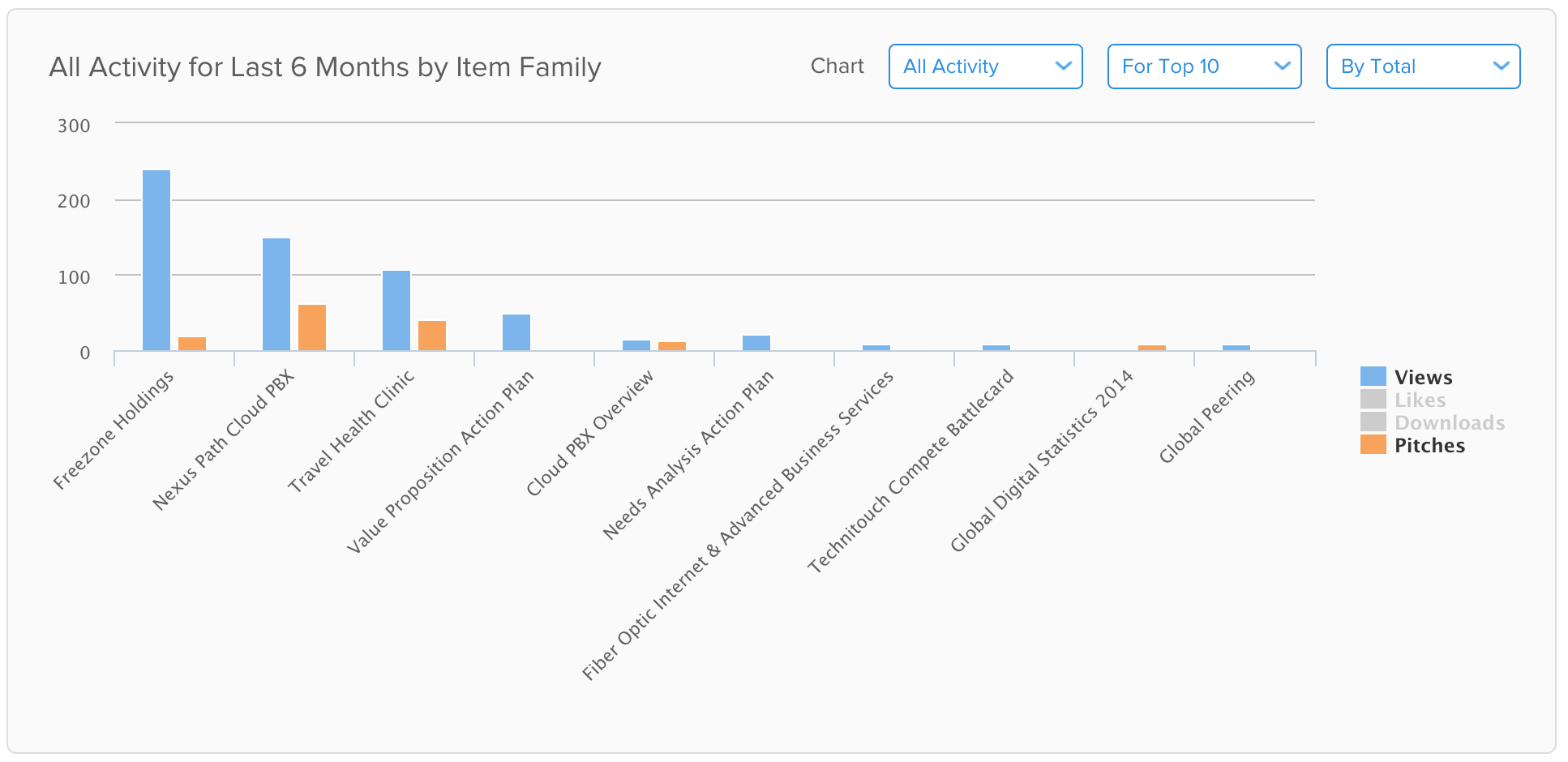
A fundamental question for sales content management teams is “Are the sales reps not using my content because they can’t find it or because they are choosing not to use it?” A report that measures the views (has a rep viewed the content), pitches (have the pitched or emailed the content) and downloads helps content owners understand why or why not their content is being used. In the figure shown, you can see that the case study “Freezone Holdings” was viewed by nearly everyone, but hardly ever used. The content owner could then follow up with sales teams to discuss why they weren’t using the new case study.
case-study-pitches
Content Usage – What content is being used in various sales deals? Which pieces are being used the most? By what segments?
SiriusDecisions research in 2015 stated that 60% of the content generated for sales is not used. One of the first things sales enablement teams must do after implementing a sales content management platform with good analytics is to understand what is being used, what isn’t, and why.
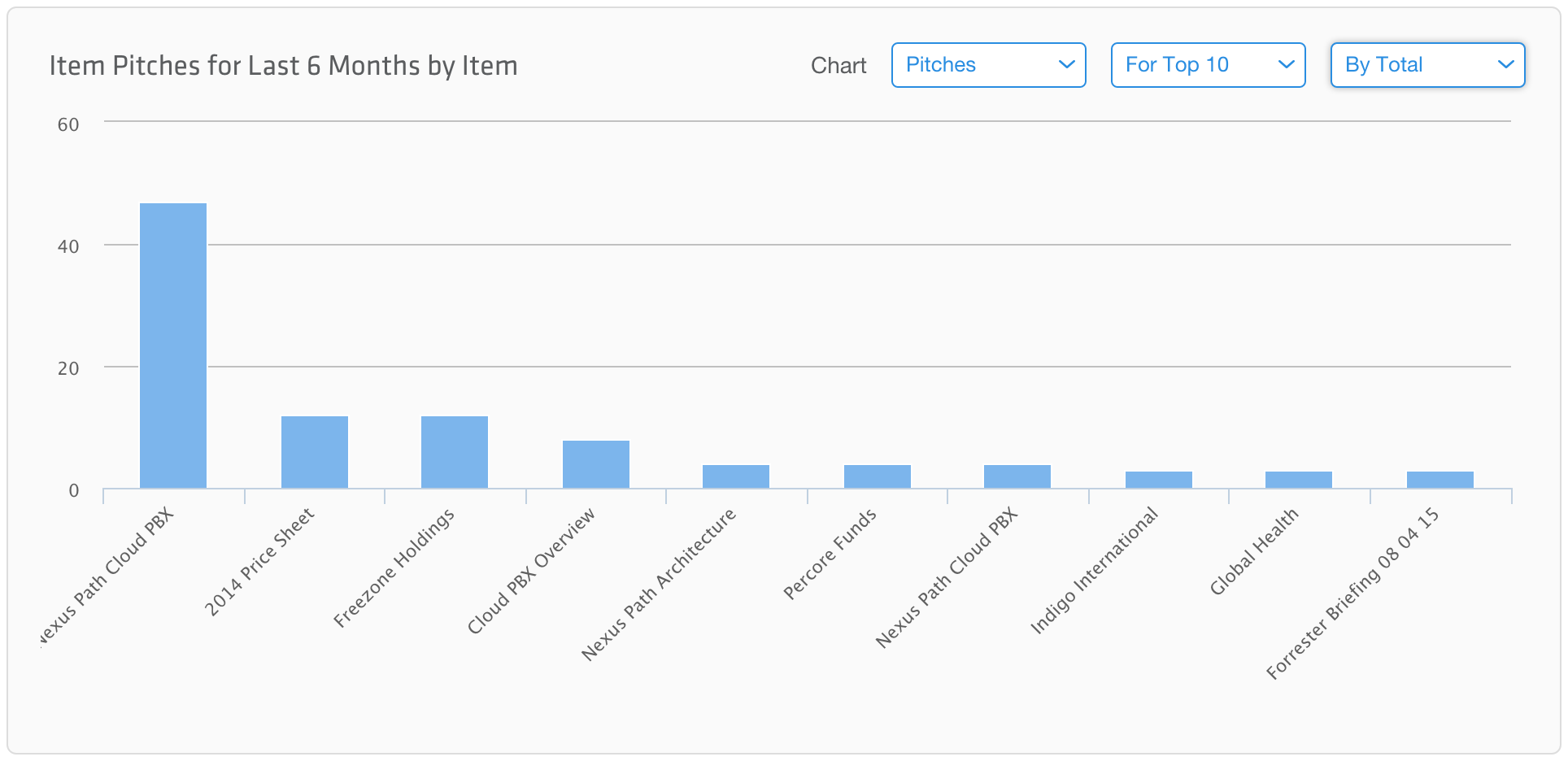
Start with a basic report on content usage (shared with the customer), first by looking at top performers and then by worst performers. Then drill into the data by sales team group, region, and product line. This often surfaces pretty useful insight. The last step is always to follow up with front line sales reps to ask why they don’t use the content. This is key to understanding how to fix it. But proper analytics will point you in the right direction and help you identify which questions to ask.
item-pitches
Pitch Activity – Track pitch activity by content piece, rep &/or account. Measure what is working and what’s not. Understand the pitching practice of your best sales personnel and share best practices with the rest of the organization.

Customer Engagement

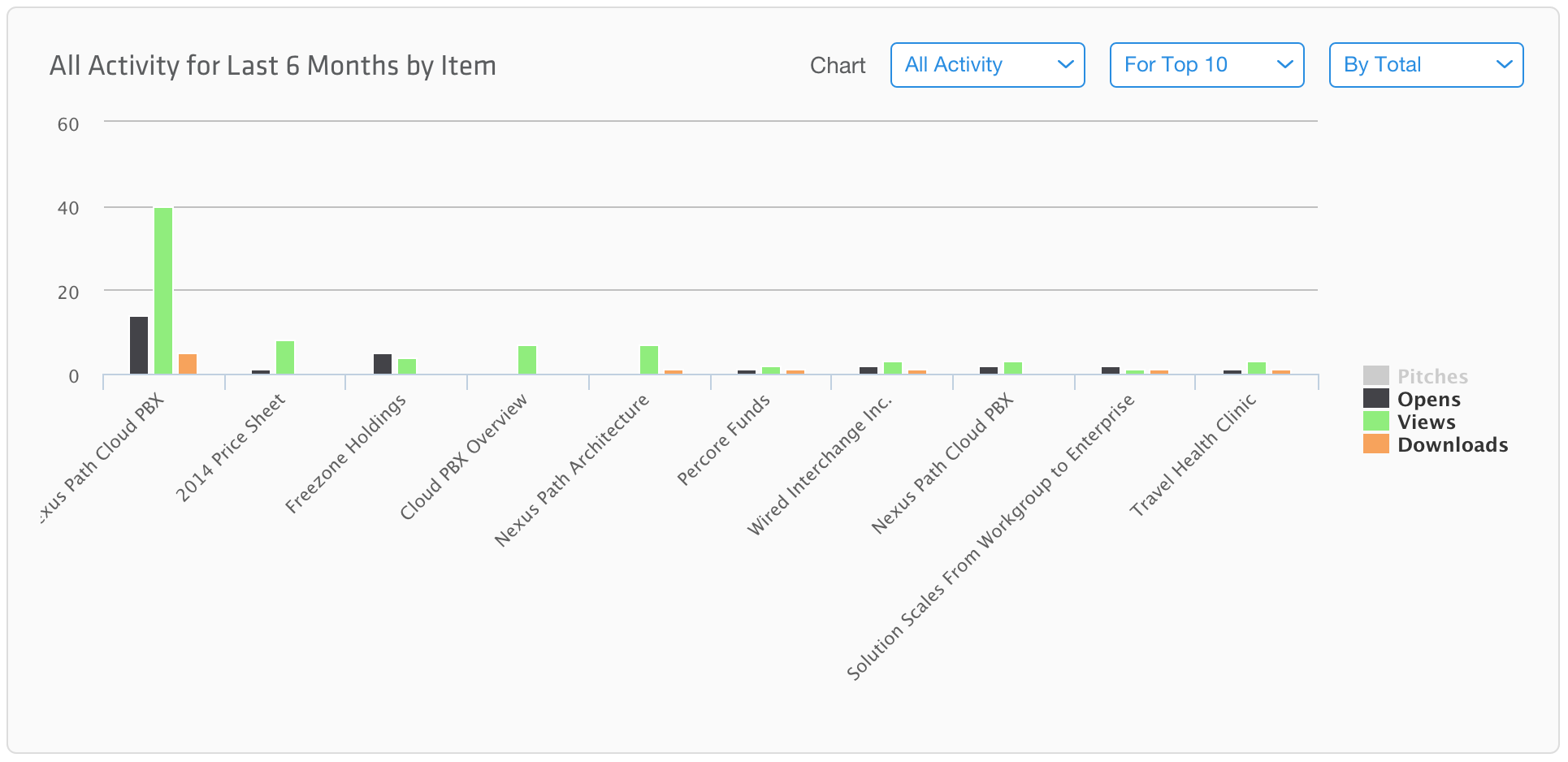
Customer Engagement – How is the customer responding to content and pitches? Measure opens, views, downloads and shares. Measure how much time customers spend on each particular page to understand what topics interest them the most.
In many respects, measuring customer engagement is the same as measuring content usage, but focused on the activities of the customer, not the sales reps. Measuring how a customer engages with your content is a powerful measure of content quality and effectiveness.
pitch-activity-graph

Content Evolution

Content Evolution – Most sales content, and particularly sales presentations, are modified in the field to customize to a specific selling situation. Often this entails updating the title of a sales presentation to customize it to the intended prospect, adding a prospect’s logo or modifying key messages to adjust to the particular sales situation. These are all practices that help engage the prospect and increase sales effectiveness. In short, these are modifications that you want your sales teams doing.
This helps marketing, too. Marketing needs to know how the content is being modified in order to improve content quality, by aligning with sales teams’ needs and getting real-time feedback on how the messaging needs to change to more effectively engage its audience.
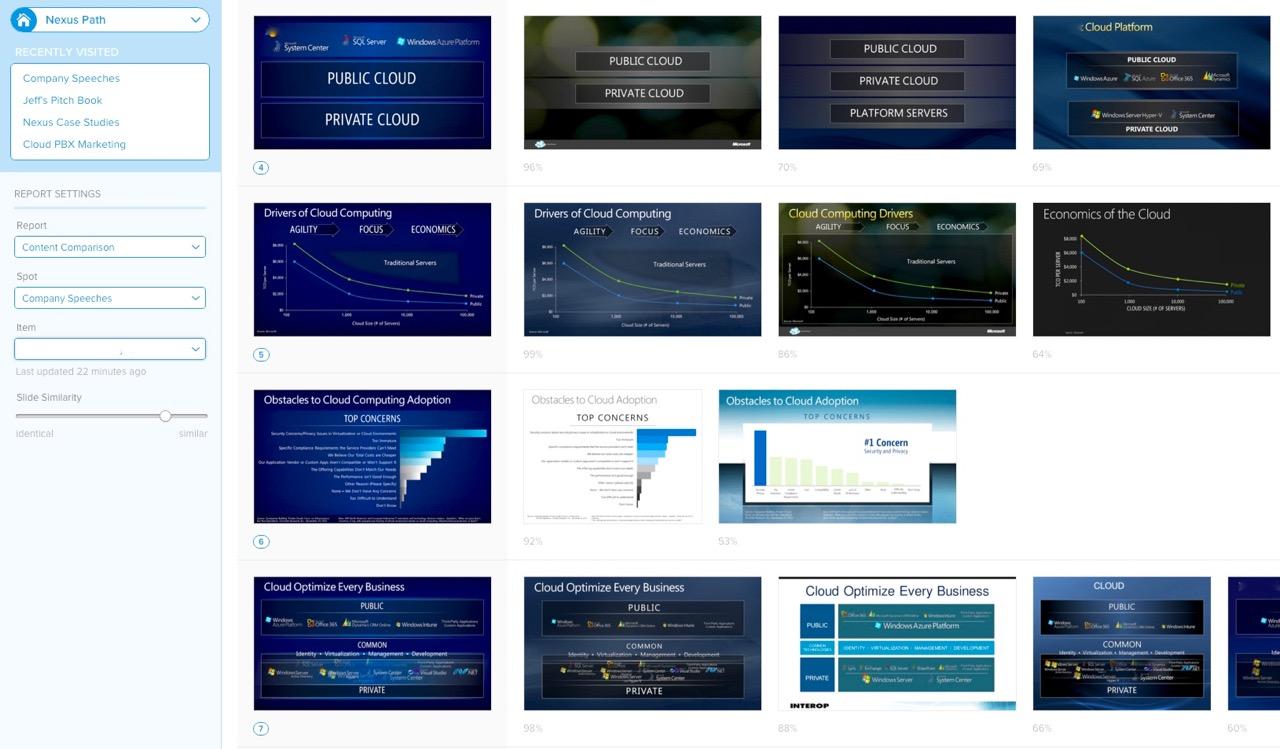
In the image below, the presentation in the column on the left is the original file. The columns to the right show slides (pages) that are similar enough to the one on the left to be considered part of the same family. In this way, content owners can see what other “similar” content is out there and how the message is evolving.
content-evolution
Performance analytics that track how content evolves provide insights into what new messages are more successful in the field are very powerful in improving content quality.
Additionally, all the content performance metrics discussed here should account for content “families” –all content that evolved from the same original piece. This is a deep pothole that many analytics solutions fall into and should be avoided. If a single sales presentation is pitched 1000 times in one month, but modified for each presentation (even a little bit), many analytics solutions treat that as 1000 different pieces of content, and in so doing, throws off all analytics on content usage, pitch performance, influenced deal conversions or influenced revenue. Only by grouping this content into a “family” of virtually the same presentation, do these analytics become useful again.

Business Impact

Influenced Revenue – Measure how content has been used to help drive revenue. What content has the biggest impact on revenue? What content is being used, but not helping close sales?
While ROI on content is not achievable, at least not yet. (I have not seen the complex attribution models necessary to accurately measure return on content. But they will come.) This is a good early proxy. By measuring the amount of revenue a piece of content has influenced, marketer’s finally have one data point on the value of content. Inherently, we know some content is used in nearly every sale. By measuring content’s usage in Closed Won deals, by revenue, it gives us a much better picture of content’s importance in the sales process.
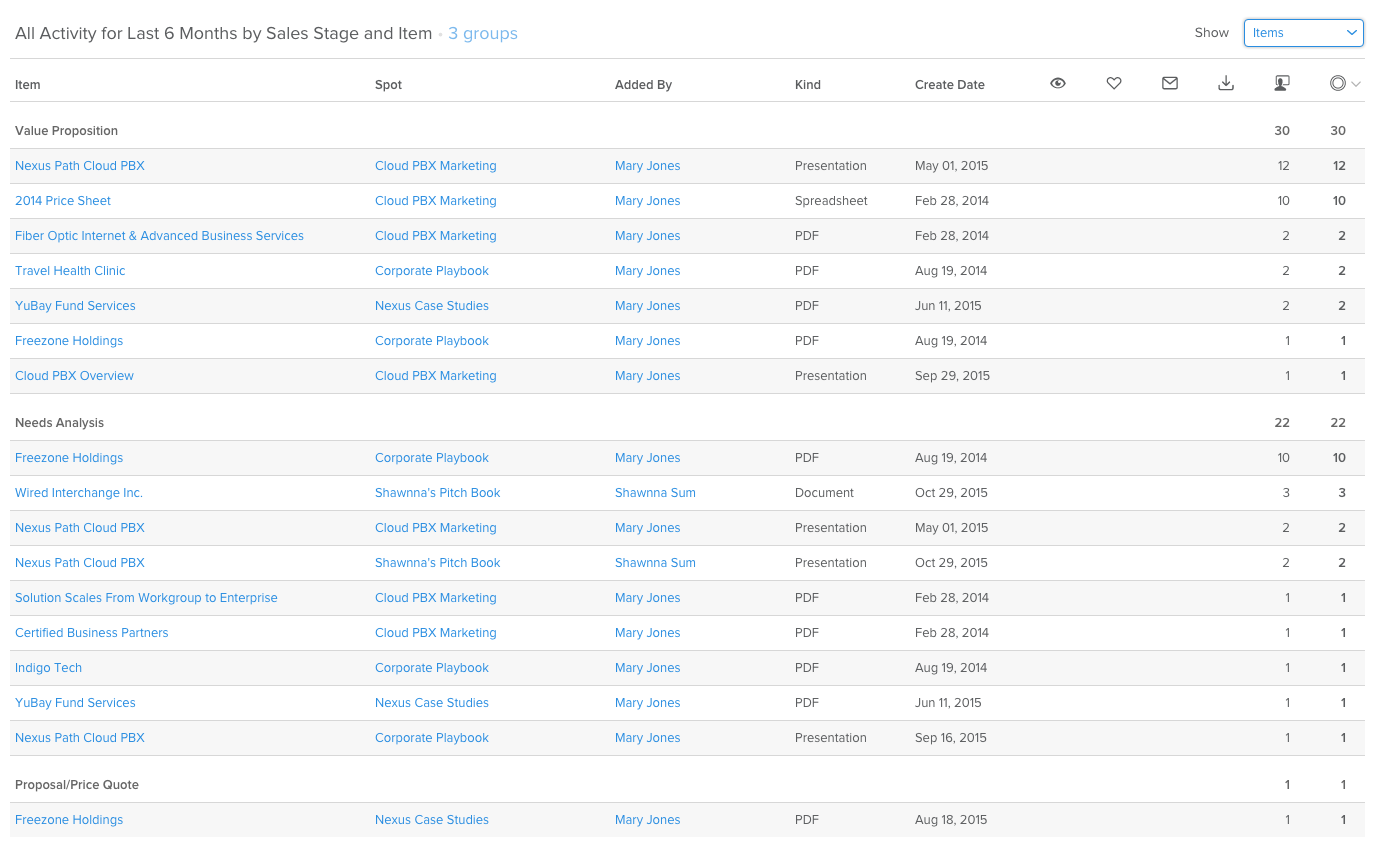
Conversion Uplift – Measure content usage against sales stage conversion rates. What content is most effective in moving a deal to the next stage?
Content should be designed to solve a specific need for a specific stage in the buyer’s journey. Measure how effective that content is in progressing the buyer to the next stage by measuring content usage in deals that advanced vs. content in deals that didn’t advance. Between this reporting capability and the content to buyer’s journey mapping exercise, content managers have the tools to know which content is most effective in advancing deals in their specific buyer’s journey stage. And that is the holy grail to improving sales content performance.
sales-content-activity

A Phased Approach

Technology has advanced considerably in the last 3-5 years to help you with this analysis. Modern Sales Enablement platforms have moved beyond being just a content repository to also providing customer engagement (email, online pitching), integration with CRM systems and content performance analytics. Most Sales Enablement platforms provide some level of reporting—often starting with content awareness and usage. Pick a platform that meets both your short-term and longer term needs. For a complete list of Sales Enablement solution providers go here.
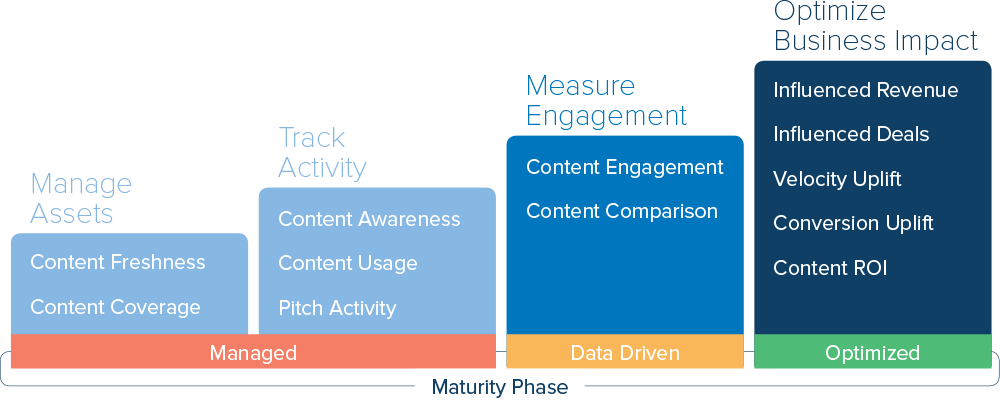
After you have put a closed-loop sales enablement solution into place, you can begin to take advantage of its features to enhance your engagement with customers. We have found that companies typically start with the basics, and then over time move to applying data-driven techniques to their entire sales process in order to analyze and optimize it.
Here is a typical path that companies follow in applying the analytics capabilities of the system.
sales-maturity-phase
It’s an evolution in which companies can very quickly establish a process to get the analytics they need to drive improvements, and then work continuously to optimize and drive greater impact. But once they have the closed-loop process for measuring content effectiveness, the improvement in content quality and sales practices drives a significant uplift in sales effectiveness.
To view the original article Click Here

Wednesday, 3 February 2016

How to Effectively Use Remarketing (Infographic)

It seems that each year that passes brings some new forms of advertising that marketers can add as another tool in their arsenal.
These past few years have brought native advertising to the mainstream, which comedian John Oliver analyzed this past August:
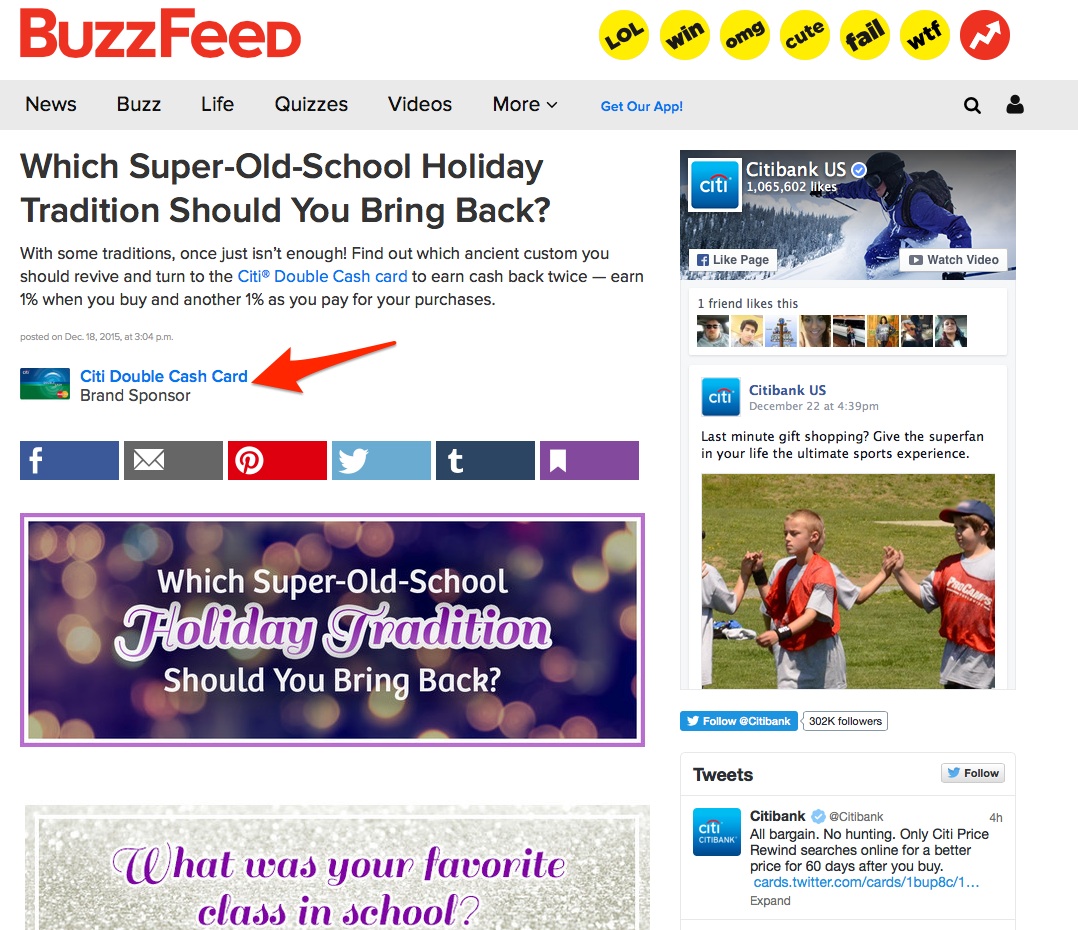
Native advertising has taken hold online. Here’s an example from Buzzfeed:
buzzfeed-native-advertising
This native advertising happens offline as well. You’ll find it in newspapers, magazines and hear it on the radio (it’s sneaky).
The web has also exploded with the growth of exit intent popups. Hover your mouse near the top of the browser to close or switch a tab and out of nowhere comes a near full page ad asking the visitor for something before they leave – typically an email address. Here’s an example, courtesy of 2xecommerce.com:
exit-intent-popup
In recent years we have also seen the growth of retargeting. This purpose of this is to advertise to people who have previously visited a specific site.
For example, let’s say you visit amazon.com today, place a few items in your cart, and leave. A few days later you’re browsing nytimes.com and see an Amazon advertisement with the products you put in your cart. You can then click the ad and are directed back to Amazon, and complete your purchase.
Sound like a new channel you’d like to test? Neil Patel of Quick Sprout has created an infographic to help you out. Whether you’re just diving into retargeting or have been around the block a few times and want a refresher on some of the principles.
How to Effectively Use Remarketing to Increase Your Revenue
Courtesy of: Quick Sprout

To view the original article Click Here
Sunday, 17 January 2016

The Demand for eBooks is Rapidly Growing – Here’s How You Can Take Advantage

The Demand for eBooks is Rapidly Growing – Here’s How You Can Take Advantage
This is a guest contribution from Jawad Khan.
Did you know that eBook sales in the US, the biggest market for digital products, is expected to reach $7.6 billion by the end of 2016?
Surprised?
In the U.S alone, eBook sales have grown almost 3000% over the last 10 years. A study by eMarketer suggests that eBook sales will outgrow the sale of mobile games in the US by the end of 2015.
The rise in eBook sales, and even free eBook downloads, is a direct result of the increase in smartphone, tablet and e-reader users.
According to Pew Research, more than 50% of American adults own either a tablet, smartphone or an e-reader device, with the majority using tablets for reading eBooks.
The Demand for eBooks is Rapidly Growing – Here’s How You Can Take Advantage

As a blogger, you should be excited reading this – really excited!
Because this not only offers you a huge money making opportunity, that is exponentially growing, but also open up several ways you can use eBooks to build a long term and viable blogging business.
However, to take advantage, you need to take action.
Why? Because research indicates that almost 81% Americans believe they should write a book, but only 1% actually do it.
That’s why it’s important that you take action.
Here are a few ways, with practical examples and relevant tools, you can use eBooks to boost sales, build your audience, and grow your business.

Use eBooks as Lead Magnets to Grow Your List

You’re a blogger and you know how important email subscribers are. There’s almost no long term and viable online business that can be built without an engaged and thriving email list.
But if you’re trying to build an email list by offering “Free Blog Updates” to your visitors, you won’t find much success (unless you’re Seth Godin of course).
To convince your readers and convert them into subscribers, you need to offer them something valuable that pulls them to your list.
In other words, you need a lead magnet.
And what type of lead magnet converts the best?
You guessed it right, eBooks!
People just love reading eBooks, and it somehow feels more valuable than other forms of lead magnets.
But don’t just take my word for it. Have a look at some of the most successful blogs, and see what their primary lead magnet is.
Bryan Harris, the owner of VideoFruit, took his blog from 0 to 10,000+ subscribers in just a few months. He has become an authority on list building.
And what does Bryan offer as his lead magnet? An eBook!
The Demand for eBooks is Rapidly Growing – Here’s How You Can Take Advantage

Ramsay grew BlogTyrant to 150,000+ subscriber. His primary offer is also a free eBook:
The Demand for eBooks is Rapidly Growing – Here’s How You Can Take Advantage
And what does Glenn from ViperChill use to attract email subscribers? You guessed it! 
The Demand for eBooks is Rapidly Growing – Here’s How You Can Take Advantage
Here’s the bottom line.
Your readers and blog visitors are MUCH more likely to subscribe to your email list if you offer them a relevant and high quality eBook.

Create the Perfect eBook for Your Audience and Make Guaranteed Money

One of the best things about blogging is that, over time, you can build a loyal community of readers around your blog.
These readers not only provide you inspiration and ideas for new content, but most of them actually start looking up to you as an authority. They are already convinced about the usefulness of your content and take your words seriously.
By identifying their biggest needs, you can create highly targeted eBooks that not only solve their problems but also fill your pockets.
Blogger and bestselling author Jeff Goins is a great example.
He started blogging just for the love of writing, and amassed an email list of more than 10,000 subscribers.
But he was making zero money from his list because he wasn’t selling them anything.
Until he decided to sell eBooks directly to his audience.
The Demand for eBooks is Rapidly Growing – Here’s How You Can Take Advantage
Jeff started by running a survey on his subscribers, and was surprised to know that the vast majority of them was willing to pay if Jeff offered them an eBook.
Fast forward two year, and Jeff has a thriving 6-figure eBook income that comes directly from his subscribers.
You can follow the same model even if you have 500-1000 email subscribers. Identify their need, and give them what they want – guaranteed sales.
There are a number of ways you can find content ideas for your eBook. You can run surveys on your blog, look at your most popular blog content, follow discussions on Quora and LinkedIn groups, and study competitor blogs.
You could also search for your main industry keywords on Ahrefs Content Explorer, and find out the posts that have attracted the highest social media shares and backlinks.
The Demand for eBooks is Rapidly Growing – Here’s How You Can Take Advantage
This will give you a good idea of the popular topics in your niche.
Once you have an idea, setting up your eBook for sale is also quite simple.
You don’t need technical expertise. There are tools and resources on the web that’ll do everything for you.
If you need to design your book cover, you can invite design proposals from freelancing portals like99Designs. Or you can do the job of a graphic designer yourself, and create eye-catching book cover designs, using Canva.
The Demand for eBooks is Rapidly Growing – Here’s How You Can Take Advantage
When it comes to selling, you can simply use third party digital selling apps like Selz, which make selling eBooks a breeze.
Selz integrates directly with your email list and allows you to accept payments using all the mainstream payment gateways. You can place your eBook in the sidebar of your blog or create a separate product widget with a Buy Now button.
The Demand for eBooks is Rapidly Growing – Here’s How You Can Take Advantage
In short, if you already have an email list you should seriously consider selling eBooks directly to your subscribers. It also gives you an opportunity to charge higher rates for your product, since your subscribers are loyal fans who’re willing to spend money in exchange for the value you’re offering.

Don’t Have a Huge List? Sell eBooks to the World

You want to write an eBook, but you can’t sell it to your blog readers and email subscribers because you don’t have a list.
No problem!
Why not sell it on the world’s biggest ecommerce portal, Amazon. Your eBook will be instantly exposed to millions of potential buyers.
Of course, the competition on Amazon is significantly higher as compared to selling directly to your blog audience but, with the right strategy and research, finding success isn’t impossible.
Need inspiration? Just look at Chandler Bolt.
This 21 year old high school dropout has become an Amazon self-publishing success story and has been featured on Huffington Post, Business Insider and several other leading websites.
The Demand for eBooks is Rapidly Growing – Here’s How You Can Take Advantage
Chandler’s accidental stardom started when he published an eBook on Amazon. Within a few weeks, his eBook had gathered dozens of sales. He’s never looked back.
In fact, this success inspired him to start his business venture Self-Publishing School that is on track to making 7 figures by the end of this year.
All because of one eBook on Amazon.
For bloggers, this is an even greater opportunity.
If you already have a blog and a thriving list, you can use your subscribers to build authority on Amazon by making sales, getting reviews and generating word of mouth.
The possibilities are endless.

Use eBooks to Build Authority, Grow Your Network and Find New Clients

Beyond lead generation and direct sales, publishing an eBook can be a catalyst for your long term business prospects.
The reason is simple, when you publish a book, people start seeing you as an authority on that subject. You start getting mentioned and quoted in your industry, you start getting authority backlinks and your brand value grows. You get opportunities to connect with the right people in your industry and expand your network.
Some of the most successful entrepreneurs got their first break when they published a book (Tim Ferris, Tony Robinson, and many others)
As a blogger, brand recognition and authority are priceless assets to have.
Just look at Seth Godin’s blog.
Writing ebooks
He hardly writes 100-300 word blog posts. They are short notes with absolutely no regard for SEO, formatting, or any of the conventional blogging advice you see.
But every post on his blog gets thousands of shares and millions of views.
Why? Because he’s an authority in his niche, and people know him by name.
While you might not be able to go straight to the level of Seth Godin, publishing an eBook would still do a lot of good for your reputation, your blog and your business.
In fact, it can change everything for your blog.

Wrapping Up

Publishing eBooks can have several long lasting effects on your blogging career and your business. With such a rapidly growing market, an ever increasing demand and so many user friendly eBook designing and selling tools, publishing an eBook is a potentially life changing opportunity that is waiting for you to take action.
As I said at the start, almost 80% people who believe they should write an eBook, never do it.
Make sure you’re not one of them.
To view the original article Click Here

Wednesday, 30 December 2015

Web Analytics: The Secret Ingredient in Lead Scoring

Lead scoring is the ultimate conversion optimization hack: if you want to make sure leads get delivered to your sales team on time and that they’re truly qualified, you need to standardize the conditions of the hand-off. Call it automated quality assurance.
A high score means prospects are very interested and intend to buy; a low score means they aren’t. Simple, right?
If you’ve done any work with lead scoring, you know that isn’t true. B2B marketers constantly test and adjust their scoring criteria as they learn more about the buying process and what factors correlate with higher conversion rates. It’s a never-ending struggle.
If your lead scoring consistently disappoints, you might be neglecting one of the lesser-known, but critical, components of lead scoring – web analytics. It’s time to use web analytics to work smarter, not harder.

Scoring Without Web Analytics

Although it’s a fairly advanced (and new) marketing automation skill, lead scoring has already gained serious clout. According to a report by Lattice and Decision Tree Labs, 44% of B2B companies use a lead scoring system.
utilizing lead scoring
But, of that group, less than half use web analytics as a scoring criterion. That might explain why 59% say “incomplete or inconsistent prospect data” shakes their confidence in scoring, and 43% say the same about a lack of “insight into which attributes indicate buying behavior.”
A lot of marketers get hung up on firmographics (company name, industry, etc.) and BANT (budget, authority, need, timeline) without realizing:
  1. Even these data points take a long time to collect without web analytics.
  2. They’re missing out on a deeper level of insight that makes lead scoring truly valuable.
When scoring is too elementary or unfairly skewed, your sales team ultimately takes the hit. They waste time following up with leads shipped over from your marketing automation platform that are nowhere near qualified. According to SiriusDecisions, only 40% of salespeople say they find lead scoring valuable.
To be effective, your scoring framework must incorporate both explicit and implicit data about your prospects — not only who they are, but how they behave. Web analytics does both.
Let’s take a look.

Identify Your Prospects

Identifying prospects is where the “who they are” comes into play. In the old days (like 5 years ago), you had to wait for prospects to fill out a web form on your site to collect basic demographic and firmographic information.
This is still a valid approach, but it’s not the only way. Think about it like this: if you’re trying to figure out what fish are in a body of water, you could drop a hook and wait for the fish to bite, or you could use a sonar transducer (i.e., “fish finder”) to scan the lakebed and provide real-time visuals.
That’s kind of what web analytics do — or at least that’s one of their capabilities. It’s called reverse IP lookup, which means using the IP address of your site visitors to identify the company they work for and geographic location. Typically, you’ll need a marketing automation platform or a dedicated web analytics app to get this kind of visibility because Google Analytics provides only an overview.
companies visiting
An example of reverse IP lookup in Act-On: site visits from users at three separate companies, by location
As you collect more information about prospects, you can match names with organizations, decide how each company fits into your target market, and assign points based on the number of hits you’ve received from that company.

Use Digital Body Language to Paint a Clear Picture

Firmographic data is a necessary part of the vetting process, but it doesn’t always indicate interest or intent. Let’s say you’re an accounting software vendor and you see that a prospect from a mid-size law firm in Boise is visiting your site. Based on previously collected information, you know the prospect’s name and job title, and everything seems to be a good fit.
Not so fast. Just because they land on your site and match a persona doesn’t make them a qualified lead. You need to know whether or not the prospect is interested in your product and whether they intend to purchase an accounting solution in the near future.
The answer to these questions can be found in the behavioral data provided by (you guessed it) web analytics. This is where the “how they behave” comes into play. By tracking how prospects engage with your website and digital content, you can determine where they are in the buying process. This collection of data is often referred to as digital body language or DBL.
To collect digital body language, your marketing automation platform (MAP) assigns each prospect a unique ID and records their actions using tracking cookies. Your job is to assign point values to each digital action based on how it indicates interest and intent.
For example, downloading a how-to guide about implementing your solution indicates fairly strong interest, so you might assign it 15 points. Reading a blog post, on the other hand, indicates only passive interest, so you might assign it 1 or 2 points.
acton scoring rules
As you can imagine, there are a lot of different factors that go into behavioral lead scoring. Here are some examples of common web activities you can track and score:

1. Pages Visited

Google Analytics will show you which pages on your site receive traffic during a specified date range. But, if you combine web analytics with marketing automation, you can identify specific users and log which pages they view.
Jonathan Doe Monsanto
In the above example, a prospect made 1 visit to our site on November 10 and viewed 6 different pages. These page visits in themselves were not enough to score points, but they did lead to a whitepaper download, which we’ll address in a moment.
In addition to tracking views, some software products let you drill down even further to see how prospects interact with a page. For example, “heat mapping” software shows you where a visitor scrolled, what they read, and what they clicked on, even if it doesn’t link to a new page.
bitcurrent home
This “confetti” map from CrazyEgg shows page clicks segmented by referral sources, search terms, and more.
If your lead scores are in a slump, it could be that visitors aren’t clicking on the right pages and CTAs. Use a tool like CrazyEgg to see which areas of your site are performing below standard.

2. Downloads / Form Completions

Using a similar back-end process, you can track which gated assets your prospects download (“gated” meaning the content is tucked behind a web form). Common examples include:
  • Whitepapers
  • E-Books
  • Research Reports
  • Case Studies
  • Webinars
unbounce tech advice
Of course, your job as a marketer is not just to track downloads but to create assets that are aligned with your funnel stages in the first place and decide how to quantify engagement with those assets.
If you can do this successfully, the payoff is huge. According to Gleanster, 68% of successful marketers say “lead scoring based on content and engagement” is ahighly effective revenue driver.

3. Online Tools Used

If you’re a B2B company, there’s a good chance you offer some kind of “tool” (or more than one) on your website. The infamous ROI calculator is a common example. At TechnologyAdvice, ours is a Product Selection Tool, which businesses use to get tailored software recommendations.
web analytics software
Online tools are a great resource for B2B purchasers and a powerful asset in the hands of a skilled marketer — because you can exchange utility for contact information. Depending on the tool’s purpose, it might also be worth some points, so you’ll need to track engagement. If you assign a specific landing page to your online tool, this will be a lot easier.
landing page acquisition
Google Analytics can provide data on how and when your online tools are being used, but again, in order to associate this data with specific lead profiles, you need to use your MAP.

4. Referring Sources / Search Terms

It’s easy to get so wrapped up in what happens on your site that you forget to look at the customer journey before the site visit — i.e., the referral. Referral data describes how a prospect ended up on your site, whether it be a search engine query, a link from a third-party website, a display ad, or a call-to-action (CTA) button in your email newsletter.
Referral data is less common than some of the other behavioral scoring metrics, but it can be incredibly useful in the right context.
To go back to the accounting software vendor example, if a prospect runs a Google search for “best accounting software for small business,” it’s pretty likely they’re in the procurement process. If you don’t assign any points, it will take that lead longer to reach the MQL stage, and in the meantime, the buyer might sign with another vendor who contacts them before you do.

5. Subscriptions and Registrations

Subscriptions (to your newsletter or blog) aren’t directly correlated with purchase intent, but they’re still worth tracking and scoring. When someone provides their contact information and chooses to receive regular updates, they’re implicitly expressing interest in a relationship with your brand. The same could be said when a prospect registers to attend a free webinar or an in-person event, which should be scored higher.
Admittedly, interest at this stage is more in your content than in your product, but that’s an excellent place to start. In his 2014 book, Epic Content Marketing, Joe Pulizzi explains how the Content Marketing Institute’s 140,000 subscribers account for the majority of their revenue. Also, once in the sales process, those subscribers close three times faster.
sign up now
Sure, a blog subscription will automatically kick the prospect’s information into your CRM database, but it’s the back-end web analytics that register the action and assign points to a lead profile.

Bringing It All Together

First, make sure you have the systems and processes in place to run lead scoring. Without the right technology, it will be impossible to track all these different metrics, not to mention analyze results and make adjustments.
If you want to connect web analytics with lead scoring, you’ll need a full-featured marketing automation platform (e.g., Act-On, Pardot, Marketo, HubSpot) — there’s no way around it. If you’re going the best-of-breed route, consider only compatible tools during your web analytics software comparison.
Second, remember that lead scoring works only if the content and campaigns behind it are flawlessly executed. You can assign 30 points to a lead because they downloaded a bottom-funnel whitepaper, but if the whitepaper itself is lousy, that lead probably won’t be excited to talk to a sales development rep.
Third, work with sales to create a shared definition of “qualified lead.” This definition will help you decide how to weight scoring criteria and where to set the threshold for an MQL.
With a calculated approach and web analytics at the helm, your conversion rate will climb, your revenue will increase, and your sales team will thank you.
To view the original article Click Here

Tuesday, 29 December 2015

5 Ways Salespeople Can Influence Marketing and Improve Your Product

Salespeople serve on your business’s front line. In their active, client-facing role, what they learn from current and potential customers can help make a company better. They often hear brilliant business ideas from the customers they aim to serve. Using their knowledge, sales teams can help their employers build better, more profitable, and popular products.
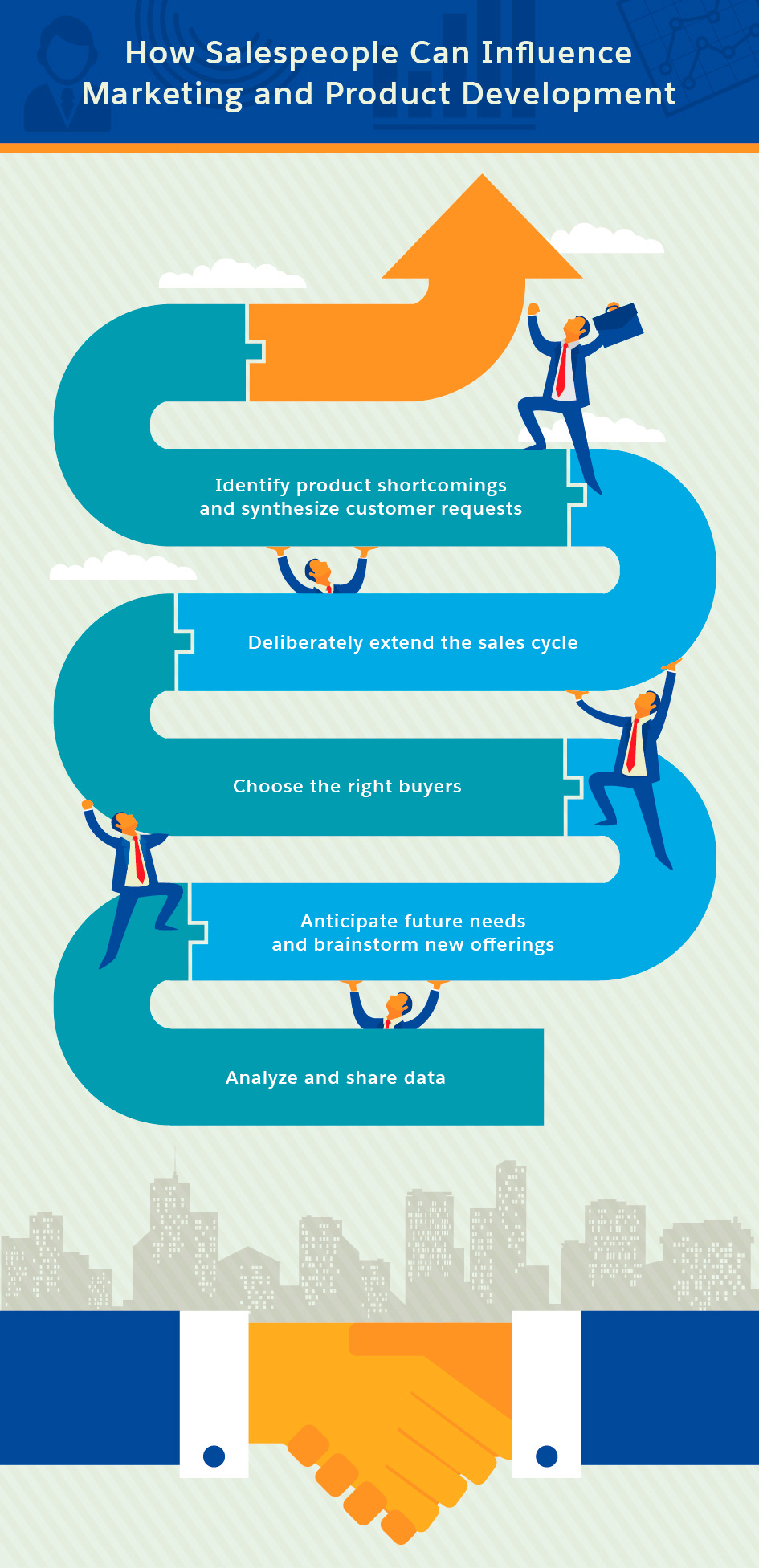
In treating their relationships with marketers as more collaborative than competitive, salespeople form value-added alliances that improve the quality and quantity of leads, thus increasing overall sales. By sharing insights gleaned from interactions with customers, sales teams can partner with engineers and product managers to drive customer satisfaction and product innovation. To have a lasting impact on their company’s approach to marketing and contribute to product development, here are five things salespeople must do.

Analyze and share data

Organizations should be open with internal data. Employees armed with sensitive information are empowered to accomplish more at their jobs. Whenever possible, sales reps should share critical sales-related performance metrics with product engineers and marketers.
Three figures worth disclosing to marketers are:
  • Number of sales qualified leads (SQLs) that converted into paying customers. With this information, marketers can get a sense of where high-converting leads are sourced. This allows them to scale those channels and ignore low-performing ones.
  • Lifetime values for every paid account. This helps marketers calculate the ROI of different lead sources so teams can focus more of their energies on identifying, attracting, and closing big-budget customers.
  • Conversion rates at each stage of the sales cycle. Some marketers mistakenly think their jobs end after they source leads and hand them off to their peers in sales. But in understanding where leaks are in the sales funnel, marketers can find opportunities to complement critical stages of the sales process. Solutions such ascontent marketingemail drip campaigns, and retargeting convince leads to give your business another chance.
Demand generation and marketing automation strategist Max Traylor suggests, “Sales can help Marketing improve their lead generation and qualification process by showing the marketing team which leads are higher quality (making it further along the sales process) and why.” Traylor adds, “If Sales doesn’t tell Marketing about unqualified leads that got passed as qualified, the same type of low quality leads will keep showing up at the top of the sales process. By having the two departments communicate with each other, you can improve sales outcomes by giving both Sales and Marketing a complete understanding of what’s working and what isn’t.”
Information sales teams should offer engineers and product managers include:
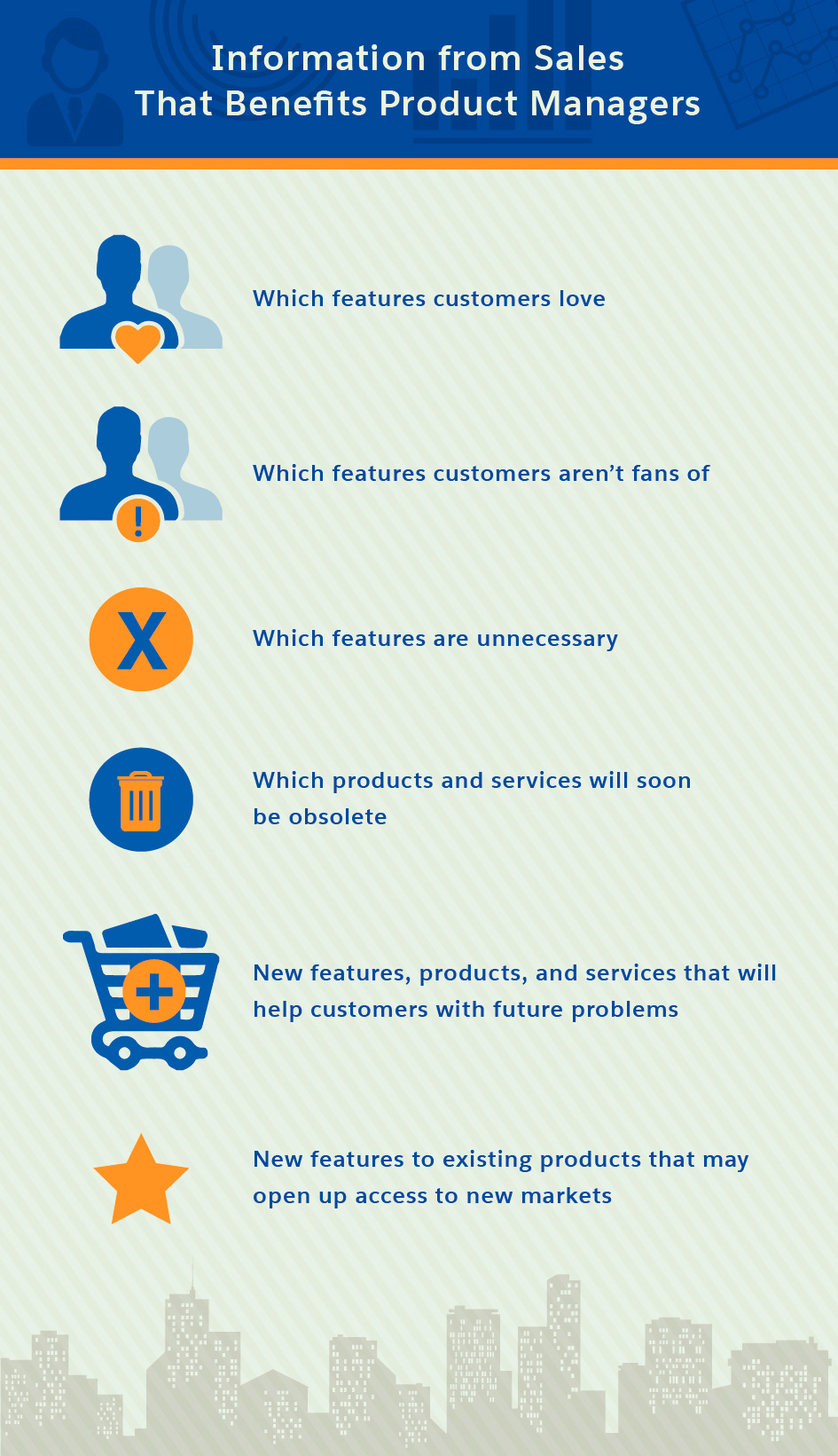
  • Stories about features customers love: A list of features that are easy to sell and can be improved to increase customer acquisition, loyalty, and retention
  • Data about features clients dislike: An estimate of how satisfied customers are with specific features to identify those that annoy or frustrate users, causing high customer turnover
  • Facts about features no one uses: Anecdotal evidence about tools users ignore that should be removed entirely
With data, companies can make more informed decisions about how best to use their resources to generate more sales from higher paying customers and where to focus their engineering efforts to output products that clients will actually use.

Anticipate future needs and brainstorm new offerings

Sales representatives are empathetic toward their customers’ needs. With an appreciation for things that impact clients’ businesses, salespeople regularly identify opportunities to help their customers grow. Successful sales teams also keep abreast of developments in the industries they sell to. Clever salespeople use that knowledge to forecast trends and brainstorm ways their business can stay ahead of the innovation curve.
According to leadership expert Michael D. Maginn, Ed.D., “[High-performing salespeople] see beyond the immediate situation to identify emerging and future needs, suggesting how these needs might be addressed, not necessarily with the salesperson’s product or service. High performers know potential problem areas, are in touch with trends other customers are engaged with, and challenge the customer to think beyond their perception of the current need.”
Ideas salespeople should relay to product managers include:
  • Entirely new inventions that solve problems clients may soon face
  • Improvements to existing products that will open up access to new markets
  • Recommendations to wind down development of current offerings that may soon become obsolete

Choose the right buyers

One of the challenges sales teams face is in finding the right buyers: customers who have the budget to buy your product, the authority to purchase it, a need for your solutions, and an opportunity to implement your offerings and extract immediate value.
To choose the right customer, Harvard Business School professor Robert Simmons suggests a four-step process. First, identify your primary customer. Make sure there’s an alignment between your company’s values and the client’s values. Know your business’s capabilities—what your core resources are and your unique competitive advantage, and which customers would be best served by your offerings. Your customer must offer you profit potential, or the ability to appropriately mark up your goods and services.
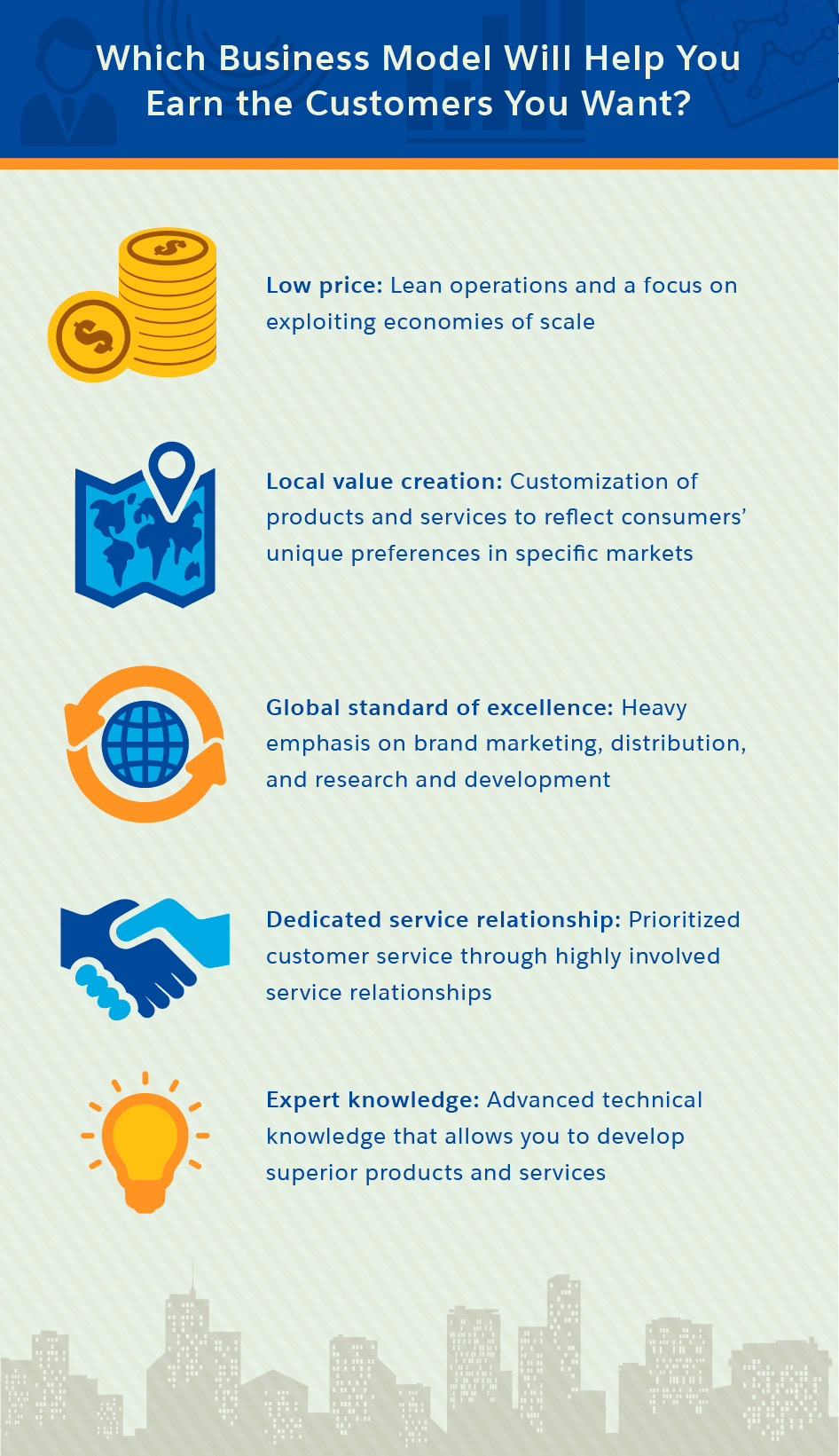
The next step is to understand customers’ values by “leveraging today’s easy and cheap access to data on customer buying habits, preferences, and search activities.” Then you can budget enough resources to win and adopt at least one of five business models: low price, local value creation, global standard of excellence, dedicated service relationship, or expert knowledge. Finally, create a fluid process that makes it easy to adapt to changes in consumer behaviour, market growth, and technological advances.
Marketers who have a firm grasp of who the right buyer is for their company can dedicate themselves to discovering where those customers live online and offline. Knowing that, marketing teams can then execute advertising, branding, and direct response campaigns that engage these prospects and deliver highly qualified leads to sales.

Deliberately extend the sales cycle

Sales advisor Kendra Lee argues firms generate ROI faster by deliberately slowing down their sales cycle. Instead of jumping from a conversation into attempting to close a deal, salespeople should take time to earn buyer trust and nurture leads. “In their haste to close a sale, they try to gather all the information needed to write a proposal in just one meeting. Then they send the proposal and try to close … without much success,” says Lee. “This ‘one-and-done’ approach is ineffective for a variety of reasons, particularly in high-stakes sales.”
Salespeople, instead, should team up with marketers to educate prospects about offerings, gather information about buyers’ motivations, and train customers to want your product. Strategic marketing campaigns, coupled with multiple sales meetings, put potential clients in a purchase-ready mindset.

Identify product shortcomings and synthesize customer requests

In conversations with potential clients, even the most talented salespeople may find their products fall short in fulfilling buyers’ needs. While a special breed of salespersoncan convince customers to forget some criteria, any smart professional would realize the long-term need to introduce new products and add extra features to current offerings. Intelligent product development allows firms to acquire more customers and retain their existing client base.
To identify product shortcomings, ask:
  • Which features do customers complain about?
  • What do customers wish you offered?
  • Which products or services have they stopped purchasing and why?
  • What improvements have they suggested?
  • Why did they say “no” to your sales proposal?
Sometimes customers demand certain improvements to products that your firm has never even considered. First, it is important to strategically gather feedback from prospects, current customers, and former clients through in-person meetings, phone conversations, email exchanges, and surveys. Next, process customer feedback into tangible feature requests or concrete examples of new product inventions. Sales representatives should focus on solutions that help customers achieve a very specific outcome. That provides the basis for profitable product innovation.
Anthony W. Ulwick wrote in Harvard Business Review, “The process of innovation begins with identifying the outcomes customers want to achieve; it ends in the creation of items they will buy. When desired outcomes become the focus of customer research, innovation is no longer a matter of wish fulfillment or serendipity; it is instead a manageable, predictable discipline.”

Final thoughts

Though salespeople are primarily responsible for securing new accounts, they have the opportunity to leverage their marketing colleagues to improve close rates, and their peers in engineering and product to develop tools that add value to users. By working closely with the marketing and product teams, salespeople help their teammates drive meaningful business results and increase their employer’s bottom line.
To view the original article Click Here