Showing posts with label SEO. Show all posts

Sunday, 29 May 2016

How to Effectively Prioritize and Amplify SEO Content

megaphone-mention-amplify-ss-1920
Many SEOs these days are focused on content marketing. This involves building out high-quality content optimized for searcher intent, then amplifying that content through social to capture end users in their moment of need.
But what are the right steps to prioritize and amplify content? Read on.

SEO content prioritization & creation

At one point in SEO, all we talked about was being “relevant” in order to rank. However, modern SEO is about being both relevant and useful; content that achieves this is exactly what Google is looking for.
You can prioritize based on intent, striking distance, search volume and (if you have them) conversion metrics. I recommend that you remove branded keywords and low search volume keywords to get a more accurate picture.

Define your goals, and find low-hanging fruit

Let’s look at your goals. If your goal is to increase traffic by 15 percent year over year, you need to put together a plan to see where you can drive incremental traffic: local, optimizing existing landing pages, building out new content, optimizing videos and so on.
As a first step, I recommend taking a look at your website analytics and ranking tools to see what opportunities there are to drive incremental traffic with your existing assets. This could be done by looking at “striking distance” keywords, which are those that rank on page 2 of the major search engines (Google, Bing and Yahoo). Moving striking distance keywords from page 2 to page 1 can drive incremental revenue and traffic, especially for keywords that have a lot of volume and transactional intent.
Pro tip: Focus on keywords that convert well from paid search and drive a lot of volume based on intent. These keywords should be your target for SEO, especially with Google’s new paid search layout pushing organic search further down the page.

Evaluate existing content and look for gaps

Determine where you need to develop useful content by conducting a gap analysis. All brands need to develop content around each stage of the buyer’s journey, as this allows you to capture search queries for many different kinds of user intent.
While many businesses understand the need to appear in search results for high-converting keywords (i.e., queries that signal intent to purchase), they often overlook the value of being visible in SERPs during the research phases of the buyer’s journey. In the digital era, this journey is not linear, but is a fragmented path to purchase — so you’ll want to be present at all stages in order to keep your brand top of mind.
Review your existing content and segment it based on intent — in other words, what stage of the buyer’s journey does it map to? From there, figure out where gaps exist, and build out content to fill in those gaps.
You can also see how your competition is doing using a tool like SEMrush, which allows you to see which keywords your competitors are ranking for. Determine where they’re visible and where they have no presence across the buyer’s journey. Take advantage of where they aren’t present by building quality content in those areas (or greatly improving existing content).

Communicate with other departments

Despite the push towards omni-channel digital marketing, many SEOs still find themselves in a silo. Having open communication with other departments (if you are in-house) or your client and their vendors (if you’re at an agency) will ensure that you are aware of any important content initiatives that need to be further optimized and prioritized.
Evaluate the content other departments are producing, prioritize it based on intent, search volume and opportunity and promote it through paid social and your existing social profiles.

Social listening

Listening to customers and finding influencers can impact visits and engagement. Social listening can give you a detailed review of your owned social landscape and competitive set. Plus, it can identify key social trends from the millions of conversations happening every day, which can help drive your content strategy by uncovering new keywords and trends that are happening now.

Content promotion

Now that you have prioritized and created your content, it’s time to promote it. The saying, “If you build it, they will come,” is sadly inaccurate. Content needs to be promoted, and a catalyst is needed to get things started.

Social amplification

Search helps social. Brands should always focus on creating high-quality and engaging content. Engaging content will be shared through social media to attract social endorsements and links, which will help improve your visibility in the search engine result pages from prioritized content.

Paid social

Paid social is a cost-effective way to help promote priority content and to drive more traffic and sales. Since paid social is relatively inexpensive, I recommend testing it to see what results you can get from paid social campaigns (e.g., an increase in links, social mentions and traffic, since they all can influence rankings).
I would only recommend putting paid support behind engaging and useful content that answers users’ questions throughout the user journey.

Final thoughts

Prioritizing content is a must for every SEO campaign to drive incremental traffic and revenue. As SEOs, we must continue to focus on building out high-quality content based on user intent that can move the needle and help our clients achieve their goals.
To view the original article Click Here

Saturday, 7 May 2016

How Long Does Link Building Take to Influence Rankings?

If you’re an SEO, chances are, you’ve recommended link building as a tactic. And, unless you work for a very trusting firm, you’ve probably been met with the question, “When will we see a return on our investment, and how much will we see?”
This is a question I’ve been asked numerous times, but never had a good answer for. The truth is, a new link doesn't affect rankings immediately. That makes it hard to tie an individual link to SERP rankings increases, since there will usually be several other links and on-page changes made to a target page between the time when you get that first link and when you finally see increases in rankings.
So, I set out to figure this out myself. I'm lucky enough to be working for a company with nearly 200,000 indexed pages, which gets hundreds of new links each month naturally, through PR and through my link building efforts. That means I've got a lot of pages that only got 1–2 links in the last 6 months, and didn't go through many on-page changes.
I picked out 76 links pointing to pages which are all similar to each other in content, and we didn't change that content (significantly) for 6 months. I focused on rankings for target keywords with a 25–35% Keyword Difficulty Rating. I looked at two versions of their target keywords, so I could have a bit more data. The results aren't super surprising to SEOs, but they're often questioned by the managers of SEOs, and now you have graphs to prove what you've been saying all along.

It takes 10 weeks on average to see 1 rank jump

This graph shows an up-and-to-the-right trend for average increase in rank over weeks after link was created.
More links do have a more immediate effect. Jacob at Exstreamist promoted some material that got him around 20 links to one of his pages, which was being outranked by other pages with about 6 more inbound links. It took his page 5–10 weeks to move from #9 to #5.
It seems that each link has a small to medium effect initially, but that effect increases over time. If you add a lot of links at once, you're not only going to see faster results, you're going to see much bigger results over time.

The lower the rank, the more effect a link has

This graph shows the average increase in rank by starting rank over weeks after link was created.
The pages that I observed that were already ranking on the first page of SERPs didn't show much of a rankings increase with one link, barely moving over one spot in 22 weeks. In contrast, pages ranking on the second or deeper pages of SERPs took off after 8–9 weeks.
Keep in mind that I am working with a fairly small data set, so I don't recommend that you promise a 10 spot jump after 22 weeks.

Higher DA will move the needle faster

This graph shows average increase in rank by Domain Authority range over weeks after the link was created.
Wondering where DA 50+ links are on this graph? I didn’t have enough to pages other than the homepage to get meaningful averages. Sorry, guys.
Unsurprisingly, a higher DA will have a bigger effect — in fact, you can see that the average rank change for a page that got a link from a site with a DA below 25 actually dropped after 13 weeks, then recovered to barely two ranks up.
I generally have a rule that I don’t want to spend any time or money on sites with DAs under 25. This chart shows that they’re not completely devoid of value, but be prepared for a very, very small change in rank with these guys.
Interestingly, both the DA 0–25 and DA 25–50 sets showed their first big jump after 10 weeks, but anecdotally, I've heard that higher DA links will have faster effects. This may be because higher DA sites get crawled more often (so the link will be discovered sooner), but I think this may be a purposeful delay in the algorithm. Google's probably taking a bit more time to trust a link from a lower-quality site.

Cool! So, if I start link building now, I'll see results in 10 weeks or sooner!

Actually, no. It takes a while to get links from a (legitimate) link building campaign. Each step is going to take a varying amount of time, based on the company you work for and the resources you already have. Here’s a list of steps you should keep in mind.

1. Getting the resources

Finding an agency (1–3 months)

The easiest route when you’re starting out is to hire an agency, since they’ll come prepared with a whole team of experienced link builders and will recommend their own tried-and-true strategies. Based on my experience watching businesses scope out Distilled when I worked there, the decision-making process is going to take you 1–3 months. It can be more if you’re a large company with a lot of bureaucracy, or if you’re trying to get a really good deal. Once you’ve chosen your partner in crime, you’ll usually have to wait a couple of weeks to a month to formally start.

Hiring a link builder in-house (1–2 months)

If it’s easier for you to hire a person than an agency, or if you think this is the best long-term strategy, you may end up needing to hire someone. The best candidates here are going to be people with link building experience, a customer service background, and/or bloggers who have successfully built up their own communities. According to Fast Company, it takes about 23 days to hire someone, so include that in your timeline.

Work with PR (almost immediate)

You can work with your PR team to start optimizing their media hits to also include good links. The success of this strategy will vary based on whether you’re going for general Domain Authority link building — in which case, all of those homepage links they’re getting will help you a lot — or trying to build Page Authority to individual landing pages, in which case they’ll probably have a hard time helping you out.
It's worth pointing out that I don't know any SEO who relies solely on PR wins to drive their link building strategy, so branch out if at all possible. If you're low on budget, though, try buying your PR team some drinks and getting them on your side.

2. Coming up with a link building strategy (2 weeks–1 month)

Once you’ve got link builders working for you, you’re going to need to come up with reasons why people will want to link to you. Here are some broad ideas, from fastest to longest ramp-up time:

Your company as a resource (1 week)

One way to get links is to find pages that are listing resources for something that your company provides. For example, if you’re Lyft, you can look for blogs and other sites that list ways you can make money with a flexible schedule.
Your potential here is going to vary based on what your company does and how well you understand the solutions your business offers and who appreciates them. Allow at least a week to prospect potential sites to reach out to.

Your expertise as a resource (2 weeks–1 month)

People are always looking for experts online, and your company probably has some valuable knowledge you can share. For example, if you’re Periscope Data, a company that lets you turn your database into graphs and tables for easier understanding, you might have a hard time finding many sites that are looking for your exact product. But you can put together advice on how to properly write SQL, and boom: thousands of more linking opportunities!
In this case, you’re going to need to both prospect to find the right sites to connect with, then you’re going to want to offer either quotes, guest posts, or resources on your site to entice them. That’ll take a few weeks to a month.

Infographics (1–3 months)

Infographics may be a little overused by SEOs, but high-quality visual assets can get a lot of attention. Just keep in mind that if you don’t work closely with your PR team, you may end up with a lot of posts sharing your infographic, but not linking back to your site.
To put together a good infographic, you’re going to need a compelling idea, clever/unique data, and a good visual designer. They’ll take you at least two months as you get started (but bank on three), though you may be able to get the time down to one month, if your company is a smoothly running machine.

In-depth research (1–3 months)

Write a really unique or really well-researched, well-written article, and you can probably get a lot of shares even without a visual component. This works best for companies that are leaders in their specific field and have a lot of data that their upper management is okay with them sharing.
Expect for this to take just as much time as an infographic — your writer needs just as much time, if not more, as a visual designer. OKCupid’s (previously) famous blog took 2–4 weeks of developer time and 4–8 weeks of a writer’s time for each post.

3. Executing (2 weeks–1 month)

Once you’ve got your strategies in place, you’re going to need to email each prospect, possibly going back and forth with them as they take their time to get back to you, post the wrong link, or need more persuading. You may get a few immediate wins, but remember that you’re not paying them, so you’re at the bottom of their priority list.

Kicking off a link building campaign? Here’s what to plan for:

  • 1–4 months: Find a link building agency and start them at the beginning of a month, OR
  • 1 month: Find an in-house link builder
  • 1 month: Come up with your top link building strategies
  • 1–3 months: Prospect for potential sites to target, and pull together the content that you need to entice those links
  • 2 weeks–1 month: Execute! It’ll take awhile to write all the emails you need to write, and respond to the feedback you get
  • 5–10 weeks: Wait for those links to take effect! Tell your team not to panic for at least 10 weeks (although effects will continue to grow beyond that)
All in all, that means that it may take you 6 months–1 year from beginning to end before you start seeing noticeable effects from your link building efforts.
As an SEO, I feel the need to reiterate: SEO is an investment. Yes, it’s going to take you a lot of time to get those results. But do you see how those rankings keep moving up and to the right, even after you’ve secured those links? Set your manager’s expectations that this is going to be a long process, but the money you pay now is going to pay off continually as long as you keep on top of your competition.
Good luck, and happy link building!

To view the original article Click Here

Tuesday, 3 May 2016

8 Old School SEO Tactics That Don't Work Anymore

8 Old School SEO Practices That Are No Longer Effective Whiteboard

Video Transcription

Howdy, Moz fans, and welcome to another edition of Whiteboard Friday. This week we're going to chat about some old school SEO practices that just don't work anymore and things with which we should replace them.

Let's start with the first one — keywords before clicks.

Look, I get the appeal here. The idea is that we've done a bunch of keyword research, now we're doing keyword targeting, and we can see that it might be important to target multiple keywords on the same page. So FYI, "pipe smoking," "tobacco smoking," "very dangerous for your health," not recommended by me or by Moz, but I thought it was a funny throwback keyword and so there you go. I do enjoy little implements even if I never use them.
So pipes, tobacco pipes, pipe smoking, wooden pipes, this is not going to draw anyone's click. You might think, "But it's good SEO, Rand. It's good to have all my keywords in my title element. I know that's an important part of SEO." Not anymore. It really is not anymore an important . . . well, let's put it this way. It's an important part of SEO, which is subsumed by wanting to draw the clicks. The user is searching, they're looking at the page, and what are they going to think when they see pipes tobacco, pipes, pipe smoking, wooden pipes? They have associations with that — spammy, sketchy, I don't want to click it — and we know, as SEOs, that Google is using click signals to help documents rank over time and to help websites rank over time.
So if they're judging this, you're going to fall in the rankings, versus a title like "Art of Piping: Studying Wooden Pipes for Every Price Range." Now, you're not just playing off the, "Yes, I am including some keywords in there. I have 'wooden' and 'pipes.' I have 'art of piping,' which is maybe my brand name." But I'm worried more about drawing the click, which is why I'm making this part of my message of "for every price range." I'm using the word "stunning" to draw people in. I'm saying, "Our collection is not the largest but the hand-selected best. You'll find unique pipes available nowhere else and always free, fast shipping."
I'm essentially trying to create a message, like I would for an AdWords ad, that is less focused on just having the raw keywords in there and more focused on drawing the click. This is a far more effective approach that we've seen over the last few years. It's probably been a good six or seven years that this has been vastly superior to this other approach.

Second one, heavy use of anchor text on internal links.

This used to be a practice that could have positive impacts on rankings. But what we've seen lately, especially the last few years, is that Google has discounted this and has actually even punished it where they feel like it's inappropriate or spammy, manipulative, overdone. We talked about this a little in our internal and external linking Whiteboard Friday a couple of weeks back.
In this case, my suggestion would be if the internal link is in the navigation, if it's in the footer, if it's in a sidebar, if it's inside content, and it is relevant and well-written and it flows well, has high usability, you're pretty safe. However, if it has low usability, if it looks sketchy or funny, if you're making the font small so as to hide it because it's really for search engines and not for searchers and users, now you're in a sketchy place. You might count on being discounted, penalized, or hurt at some point by Google.

Number three, pages for every keyword variant.

This is an SEO tactic that many folks are still pursuing today and that had been effective for a very long time. So the idea was basically if I have any variation of a keyword, I want a single page to target that because keyword targeting is such a precise art and technical science that I want to have the maximum capacity to target each keyword individually, even if it's only slightly different from another one. This still worked even up to four or five years ago, and in some cases, people were sacrificing usability because they saw it still worked.
Nowadays, Google has gotten so smart with upgrades like Hummingbird, obviously with RankBrain last year, that they've taken to a much more intent- and topic-matching model. So we don't want to do something like have four different pages, like unique hand-carved pipes, hand-carved pipes, hand-carved tobacco pipes, and hand-carved tobacco smoking pipes. By the way, these are all real searches that you'll find in Google Suggest or AdWords. But rather than taking all of these and having a separate page for each, I want one page targeting all of them. I might try and fit these keywords intelligently into the content, the headline, maybe the title, the meta description, those kinds of things. I'm sure I can find a good combination of these. But the intent for each of these searchers is the same, so I only want one page targeting them.

Number four — directories, paid links, etc.

Every single one of these link building, link acquisition techniques that I'm about to mention has either been directly penalized by Google or penalized as part of an update, or we've seen sites get hit hard for doing it. This is dangerous stuff, and you want to stay away from all of these at this point.
Directories, well, generic directories and SEO directories for sure. Article links, especially article blasts where you can push an article in and there's no editorial review. Guest content, depending on the editorial practices, the board might be a little different. Press releases, Google you saw penalized some press release websites. Well, it didn't penalize the press release website. Google said, "You know what? Your links don't count anymore, or we're going to discount them. We're not going to treat them the same."
Comment links, for obvious reasons, reciprocal link pages, those got penalized many years ago. Article spinners. Private link networks. You see private and network, or you see network, you should just generally run away. Private blog networks. Paid link networks. Fiverr or forum link buys.
You see advertised on all sorts of SEO forums especially the more aggressive, sketchy ones that a lot of folks are like, "Hey, for $99, we have this amazing package, and I'll show you all the people whose rankings it's increased, and they come from PageRank six," never mind that Page Rank is totally defunct. Or worse, they use Moz. They'll say like, "Domain authority 60-plus websites." You know what, Moz is not perfect. Domain authority is not a perfect representation of the value you're going to get from these things. Anyone who's selling you links on a forum, you should be super skeptical. That's somewhat like someone going up to your house and being like, "Hey, I got this Ferrari in the yard here. You want to buy this?" That's my Jersey coming out.
Social link buys, anything like this, just say no people.

Number five, multiple microsites, separate domains, or separate domains with the same audience or topic target.

So this again used to be a very common SEO practice, where folks would say, "Hey, I'm going to split these up because I can get very micro targeted with my individual websites." They were often keyword-rich domain names like woodenpipes.com, and I've got handmadepipes.net, and I've got pipesofmexico.co versus I just have artofpiping.com, not that "piping" is necessarily the right word. Then it includes all of the content from all of these. The benefit here is that this is going to gain domain authority much faster and much better, and in a far greater fashion than any of these will.
Let's say that it was possible that there is no bias against the exact match domain names folks. We're happy to link to them, and you had just as much success branding each of these and earning links to each of these, and doing content marketing on each of these as you did on this one. But you split up your efforts a third, a third, a third. Guess what would happen? These would rank about a third as well as all the content would on here, which means the content on handmadepipes.net is not benefitting from the links and content on woodenpipes.com, and that sucks. You want to combine your efforts into one domain if you possibly can. This is one of the reasons we also recommend against subdomains and microsites, because putting all of your efforts into one place has the best shot at earning you the most rankings for all of the content you create.

Number six, exact and partial keyword match domain names in general.

It's the case like if I'm a consumer and I'm looking at domain names like woodenpipes.com, handmadepipes.net, uniquepipes.shop, hand-carved-pipes.co, the problem is that over time, over the last 15, 20 years of the Web, those types of domain names that don't sound like real brands, that are not in our memories and don't have positive associations with them, they're going to draw clicks away from you and towards your competitors who sound more credible, more competent, and more branded. For that reason alone, you should avoid them.
It's also that case that we've seen that these types of domains do much more poorly with link earning, with content marketing, with being able to have guest content accepted. People don't trust it. The same is true for public relations and getting press mentions. The press doesn't trust sites like these.
For those reasons, it's just a barrier. Even if you thought, "Hey, there's still keyword benefits to these," which there is a little bit because the anchor text that comes with them, that points to the site always includes the words and phrases you're going after. So there's a little bit of benefit, but it's far overwhelmed by the really frustrating speed bumps and roadblocks that you face when you have a domain like this.

Number seven — Using CPC or Adwords' "Competition" to determine the difficulty of ranking in organic or non-paid results

A lot of folks, when they're doing keyword research, for some reason still have this idea that using cost per click or AdWords as competition scores can help determine the difficulty of ranking in organic, non-paid results. This is totally wrong.
So see right here, I've got "hand-carved pipes" and "unique wooden pipes," and they have an AdWords CPC respectively of $3.80 and $5.50, and they have AdWords competition of medium and medium. That is in no way correlated necessarily with how difficult they'll be to rank for in the organic results. I could find, for example, that "unique wooden pipes" is actually easier or harder than "hand-carved pipes" to rank for in the organic SEO results. This really depends on: Who's in the competition set? What types of links do they have and social mentions do they have? How robust is their content? How much are they exciting visitors and drawing them in and serving them well? That sort of stuff is really hard to calculate here.
I like the keyword difficulty score that Moz uses. Some other tools have their own versions. Doctor Pete, I think, did a wonderful job of putting together a keyword difficulty score that's relatively comprehensive and well-thought through, uses a lot of the metrics about the domain and the page authority scores, and it compensates for a lot of other things, to look at a set of search results and say, "This is probably about how hard it's going to be," and whether it's harder or easier than some other keyword.

Number eight — Unfocused, non-strategic "linkbait"

Last one, some folks are still engaging in this, I think because content strategy, content marketing, and content as a whole has become a very hot topic and a point of investment. Many SEOs still invest in what I call "nonstrategic and unfocused link bait." The idea being if I can draw links to my website, it doesn't really matter if the content doesn't make people very happy or if it doesn't match and gel well with what's on my site. So you see a lot of these types of practices on sites that have nothing to do with it. Like, "Here are seven actors who one time wore too little clothing." That's an extreme example, but you get the idea if you ever look at the bottom ads for a lot of content stuff. It feels like pretty much all of them say that.
Versus on topic link bait or what I'd call high quality content that is likely to draw in links and attention, and create a positive branding association like, "Here's the popularity of pipes, cigarettes, electronic cigarettes, and cigars in the U.S. from 1950 to today." We've got the data over time and we've mapped that out. This is likely to earn a lot of links, press attention. People would check it out. They'd go, "Oh, when was it that electronic cigarettes started getting popular? Have pipes really fallen off? It feels like no one uses them anymore. I don't see them in public. When was that? Why was that? Can I go over time and see that dataset?" It's fundamentally interesting, and data journalism is, obviously, very hot right now.
So with these eight, hopefully you'll be able to switch from some old school SEO techniques that don't work so well to some new ways of thinking that will take your SEO results to a great place. And with that, we'll see you again next week for another edition of Whiteboard Friday. Take care.
To view the original article Click Here

Sunday, 24 April 2016

30 Quick and Easy SEO Tips for Small Businesses

For the uninitiated, SEO can seem to be a complex and foreign landscape, but it doesn’t have to be too complicated.
Indeed, there’s a lot that small businesses (and anyone) can do without any great SEO knowledge, and without spending too much money.
With the help of some search experts, I’ve compiled a list of tips (in no particular order)…

1. Set up a Google My Business account

Set this up and get all of your business details uploaded. It’s totally free and will enable you to appear in local search results for queries specific to your area of operation.
Even broad queries with large volumes are now showing local results which is something small business owners can capitalise upon.
/IMG/127/336127/girl-goat-chicago

2. Build a fast, mobile-friendly website

Developing mobile sites can now be done easily with simple plugins for your CMS, such as WordPress, meaning that making all of your content mobile-friendly can be done quickly and cheaply.
Optimising it for fast load-speed (again through plugins where available) will help you stand out from the competition in terms of performance.

3. Conduct extensive keyword research to identify gaps in the market

Targeting the same keywords as your bigger competitors won’t see you make much ground as they are more established and have more coverage online.
Using keyword research tools such as Google’s Keyword Planner to spot gaps in the market will enable you to capitalise upon these – they may even convert at a better rate too.
Tips 1-3 by Jamie White, Head of Technical SEO at Search Laboratory.

4. Start using Google Search Console

It’s a free tool that gives a wealth of information about your website’s performance in Google search, as well as any errors on your site and issues you should address.
Improving your website without Search Console is like running a marathon without any shoes on. With Search Console you can find out what keywords Google thinks your website is relevant for, whether there are problems crawling your website, if your site is mobile friendly, and much more. It’s the starting point for most of your improvement efforts.

5. You need to understand your online audience through and through

Who is your typical online customer? What are they looking for? How do they spend their time online? What kind of content do they like to consume?
When you completely understand your audience, you will understand what you need to do online to grab their attention.
If your audience spends a lot of time on Facebook, you should focus effort there. If your audience reads online tutorials about topics relevant to your niche, maybe you need to produce your own tutorial content.
Without a thorough understanding of your audience’s needs and requirements, you won’t be able to make effective use of the online channels at your disposal – you’ll just be trying out different things at random, and that’s a terrible waste of your precious resources.

6. Look at how search engines are displaying results in your niche

Too often, small businesses have no idea who or what they are actually competing with in search.
For example, if you want to focus on a keyword that has a lot of huge international companies ranking on the first page, you should realise that perhaps your expectations need to be tempered.
Another example: if search engines show a lot of images or videos in their results for keywords you want to be visible for, you should consider producing that sort of content rather than just focus purely on text.
Also, often search engines will show local business results – if that’s the case, your efforts need to be adjusted to focus on achieving visibility in those types of results.
cake
Tips 4-6 by Barry Adams, Polemic Digital

7. Get ScreamingFrog and check your site for possible onsite issues

Watch for security issues too – Sucuri site check is free and while it won’t be able to see all possible issues it can catch some of the most widespread ones.
This may seem unrelated to the topic of this article but compromised sites do lose their traffic and visibility.

8. Claim your physical address on Google Maps

If it’s a local business which a physical location and offline customers, make sure you claim your physical address on Google Maps.

9. Whatever you do, be genuine

Hiring somebody on the cheap to run  your Twitter account or build links for you may seem like a tempting  idea but it can – and probably will – backfire.
If you haven’t got  much of a marketing budget, take one step at a time but do it yourself as nobody knows your business and your customers better than you. Connect with them personally, do not count on somebody else spamming them on your behalf resulting in any positive outcome.
Tips 7-9 by Julia Logan, Irish Wonder

10. Beware of agencies that promise the earth

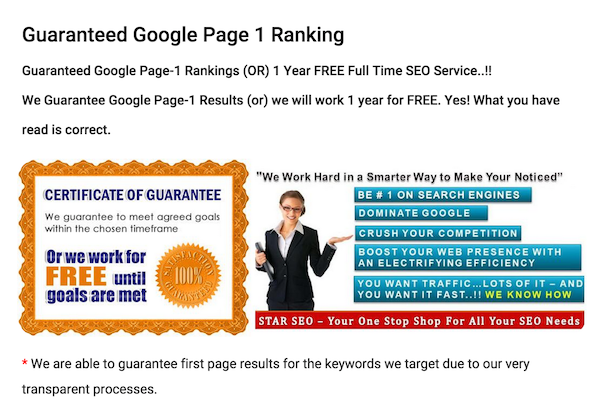
Unless you’re prepared to buy PPC ads, then there is no way to guarantee a page one listing (even then it can be tricky on competitive terms).
If an agency or salesperson promises you this, ignore them. They’re lying and will likely do a lot of damage to your long-term search visibility.
page one guaranteed
Also, if you’re just getting started, you don’t necessarily need an agency to improve your SEO efforts. See what you can do yourself first.

11. If you do hire an agency, keep an eye on them

Agencies using the wrong methods can do a lot of damage.
Often by dodgy link-building which may achieve some short-term results but will expose your site to the risk of penalties long-term.

12. Keep up with industry news

Things can change fairy quickly in SEO, so things that work for a while can become against Google’s rules over time.
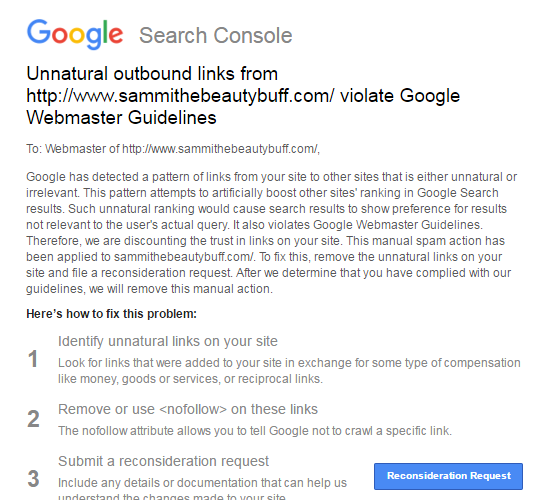
As with the recent penalties for bloggers reviewing products, Google will rarely spell things out. It will give advice and hints, but it won’t contact you. You’ll often only know you’ve done something ‘wrong’ when you login to Google Search Console and receive a notice like this:
Google penalty

13. Try not to rely too much on Google

Yes, it’s well worth working to improve your rankings, and search traffic is valuable, but don’t put all of your eggs in one basket.
Google can change the way it ranks sites, the way it display results at any time, in ways which could adversely affect your search traffic.
Look to build email lists, use social media etc so that you’re attracting customers from a range of sources.

14. Launch a blog / create content

Content is what will help you rank for your target terms. This means content on product pages, homepages and everywhere around the site, but a blog can also help.
It shouldn’t be done just for SEO reasons, as blogs present an opportunity for you to talk about your product and services and the issues around them.
It means you can create the kind of content that people interested in your product or service would appreciate, and begin to build an audience.

15. If you blog, do it regularly

You don’t have to write five articles a day, but regular updates mean your visitors have something to read, and you’ll also be creating fresh content for the search engines.

16. But don’t go keyword-crazy

Yes, you want to target the terms that your customers are likely to search for, but you have to write for humans first of all, or your content will be weak.

17. Aim for evergreen content

Look to create quality content that addresses customers issues and has a longer shelf-life. This‘evergeen content’ is more likely to achieve search rankings over a longer period of time.
evergreen

18. Use a clear URL structure

People should be able to guess the topic of a page just by looking at the URL.

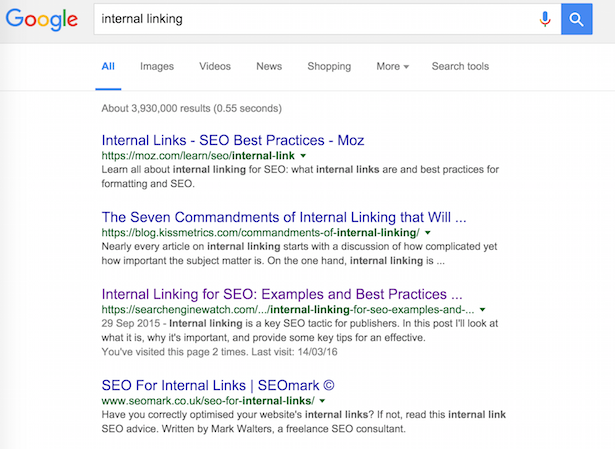
19. Use internal linking to optimise your site

Effective internal linking is about linking topics and themes together in a more sensible way, for readers and for search engines.
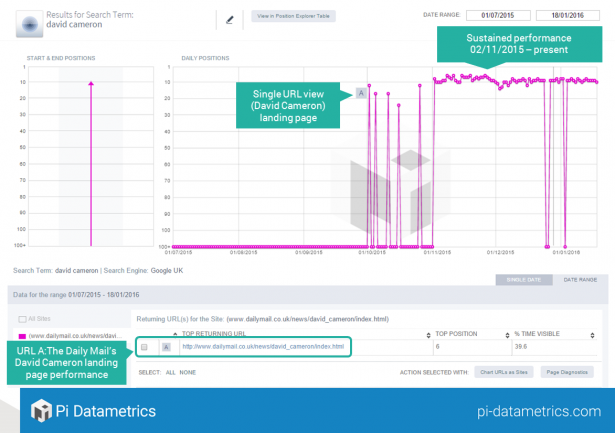
For example, if you are providing cake-decorating services, you’ll have lots of articles using that phrase. They’re not all going to rank for that, so choose the page you’d most like to rank for that term and point the links at that.
It can be very effective, as this internal linking example from the Daily Mail website shows.
David Cameron landing page

20. Use your site search data to find terms to target

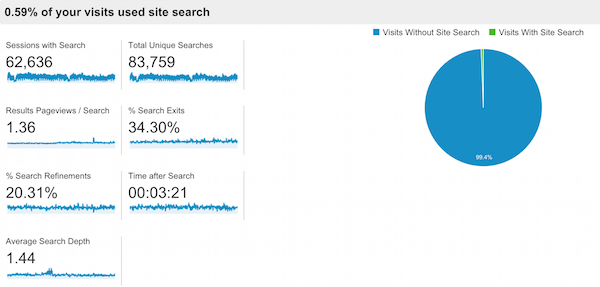
You can view the terms your visitors search for on site by looking into your analytics data.
You can learn a lot from this site search data, which can help in many ways.
For search, the keywords that people use on your site could be terms that you aren’t currently targeting via SEO or PPC.
If so, analysing site search data is a great way to find more relevant terms to target. They also tell the the kind of language that customers use.
/IMG/908/333908/clickz-site-search-usage

21. Encourage reviews

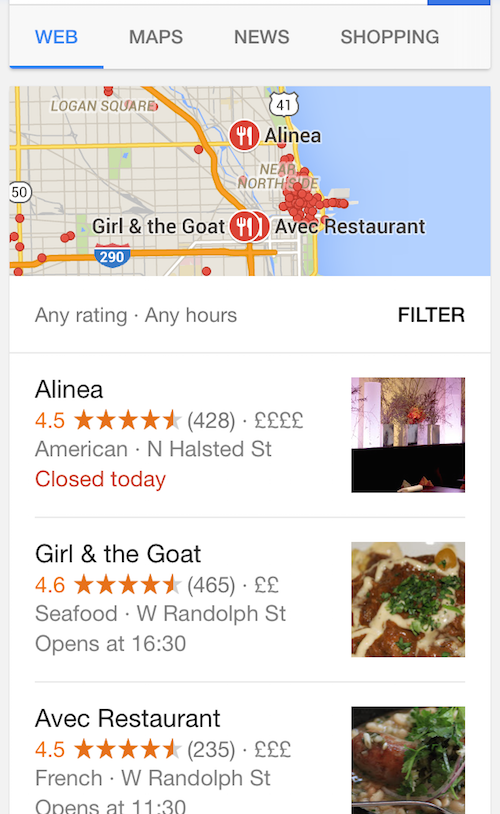
Reviews will help to drive conversions but, from an SEO perspective, they help to drive your local SEO visibility.
/IMG/955/335955/chicago-rest

22. Optimize images

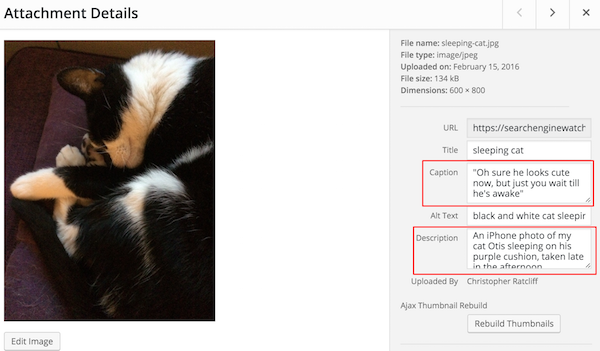
In this article, SEW Editor Christopher Ratcliff explains how to optimize images for SEO, with the help of his cat.
wordpress photo upload highlighting caption and description

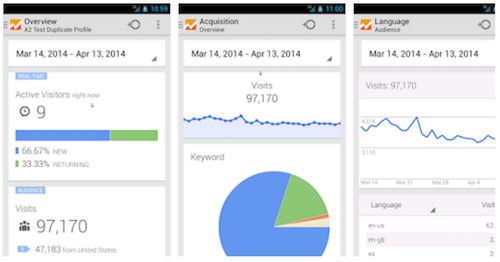
23. Set up Google Analytics

It’s free and it’s essential for you to understand customer behaviour, traffic sources and more.
Here’s a beginner’s guide to Google Analytics.
 Google Analytics app

24. Think about UX

For one thing, after mobilegeddon, your mobile ranking depends on factor related to UX.
Site speed is just one. Use tools like Google’s pagespeed insights to learn about your site and how to improve it.

25. Optimize your Google My Business profile

The basics should be there – if you have a physical store, provide opening times, directions and other useful information.
Don’t leave it at that though. Add images, regular updates and more.

26. See who is linking to you and learn from it

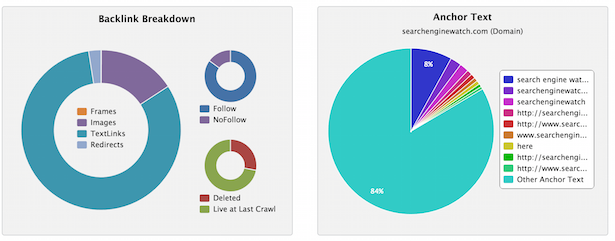
You can view the links you receive through tools like Majestic and others. Are you attracting links from relevant sites? If so, which kinds of content / pages are attracting these links?
backlinks

27. Write a unique title for every page

On Google, you have around 55 characters to make the topic of a page clear to searchers and search engines.
page titles google

28. Don’t expect results too quickly

The tips here will produce results, but don’t expect overnight success. Good SEO can take time, so be patient and stick with the process.

29. Use a little PPC

If you have the budget, PPC can deliver traffic more quickly.
It can also inform your SEO efforts – you can see which keywords work best for conversions and can help you to improve your landing pages.

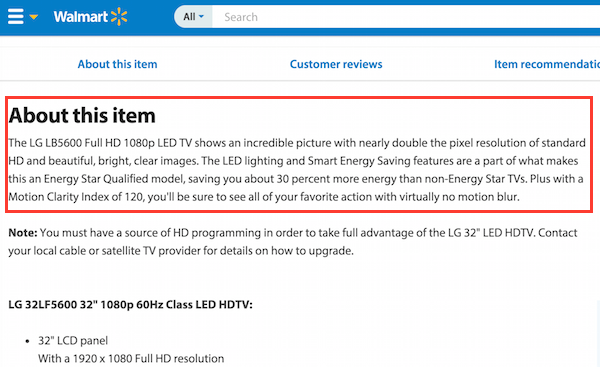
30. Write your own product page copy

If you’re selling products that other sites will also have, unique product descriptions can help your site to stand out.
They’re also better for conversions, as the manufacturer descriptions will not have been tested for effectiveness, whereas you can try variations and see what works best for your site
duplicate-product-copy
What have I missed? Add your tips below…
To view the original article Click Here