
Showing posts with label marketing mistakes. Show all posts

Tuesday, 5 April 2016

How to Turn a Marketing Faux Pas into a New Customer

No matter how hard we try, we will never be perfect. This is true for businesses, too, especially in their marketing efforts. No matter how hard they try to create the right message for an audience, mistakes happen. However, those mess-ups don’t have to be fatal. It is possible to turn a marketing faux pas, such as typos, product issues, and poor messaging, into genuine opportunities to connect with your target audience.
Your ideal customers are looking for companies that are genuine and quick to fix mistakes. Consumers are savvy: Trying to cover up a mistake and hoping it goes away can make it much worse. Instead, use the opportunity to gain customer trust. This can resolve the situation with a happier ending: a sale or loyal advocate for your brand.
Below are some of the most common marketing faux pas and how companies can not only work through them, but gain respect along the way.

Order or Customer Information Errors

Two of the most common mistakes in marketing are errors and typos.. Examples include addressing a customer by the wrong name in an email blast, or customers seeing the placeholder of [FIRSTNAME] due to an autofill glitch. Even though customers know you send emails out to many people, they may take it personally when there are errors in communication.
If a customer emails you with an error concerning their account, whether it’s their name or other personal information, it’s important to communicate how badly the company feels for this error. A touch of human humility goes a long way to remedy this mistake.
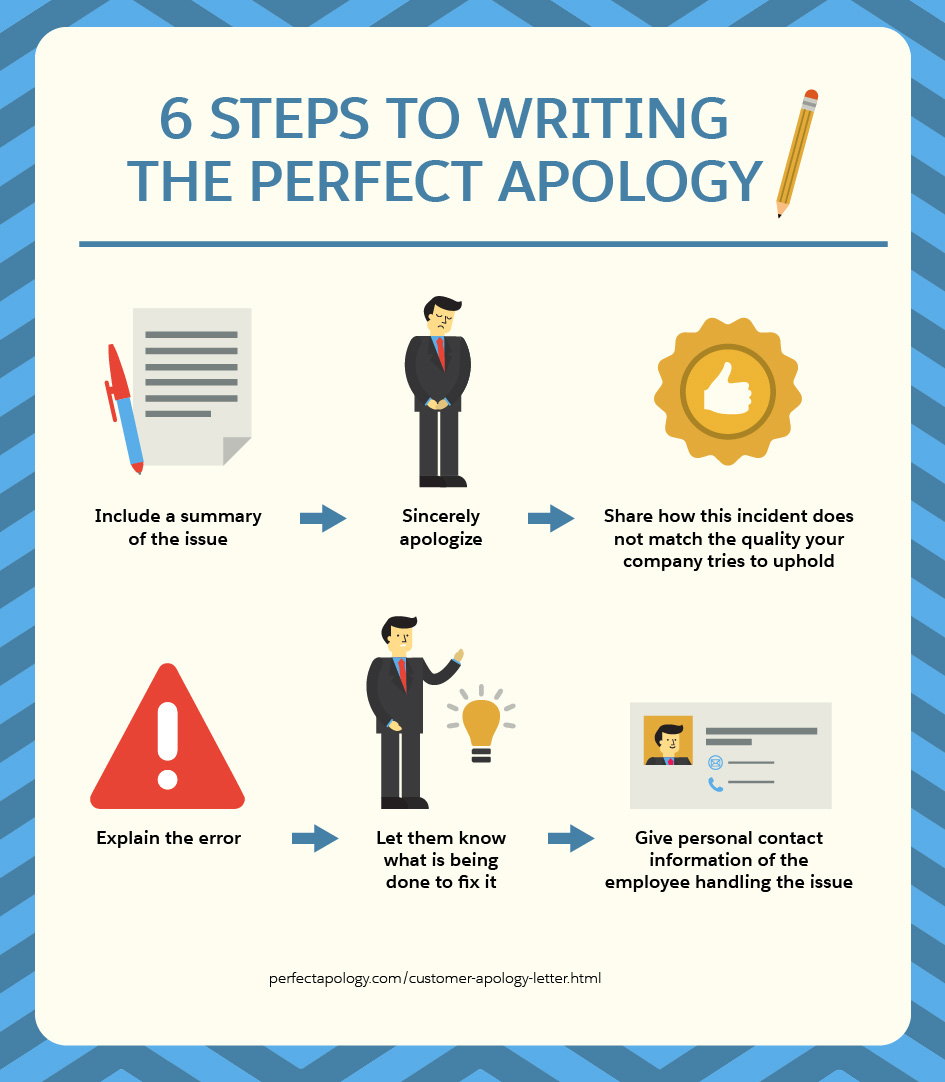
According to PerfectApology.com, the right customer apology letter for a mistake needs to include:
  • A summary of the issue
  • A sincere apology and statement of quality that the company tries to uphold
  • An explanation of the error
  • What is being done to fix it
  • Personal contact information of the employee handling the issue in case the customer has more questions they want answered directly
While the length of your apology will depend on the error, it’s important that it gets the point across succinctly. Make sure to send it as soon as possible. Customers will appreciate your speedy reply and apology.
In order to remedy the problem, do what it takes to make it right. This might be letting the customer keep the wrong product, or giving them an exclusive coupon code or gift card for causing an inconvenience.  
Going above just apologizing is what makes the interaction memorable for the customer. Any company can say, “I’m sorry.” It takes a great company to say, “I’m sorry, and here’s what I’m doing to fix it.”

Insensitive Messaging

In the fire hydrant of content and offers on the Internet, there are more chances than ever to accidentally send out a marketing message or image that may be taken in a way that wasn’t intended. A simple social media post can go wrong if there aren’t enough checks and balances in place to catch sensitive issues, or if you don’t have someone to consult to make sure the message can’t be construed as something beyond the desired intent.
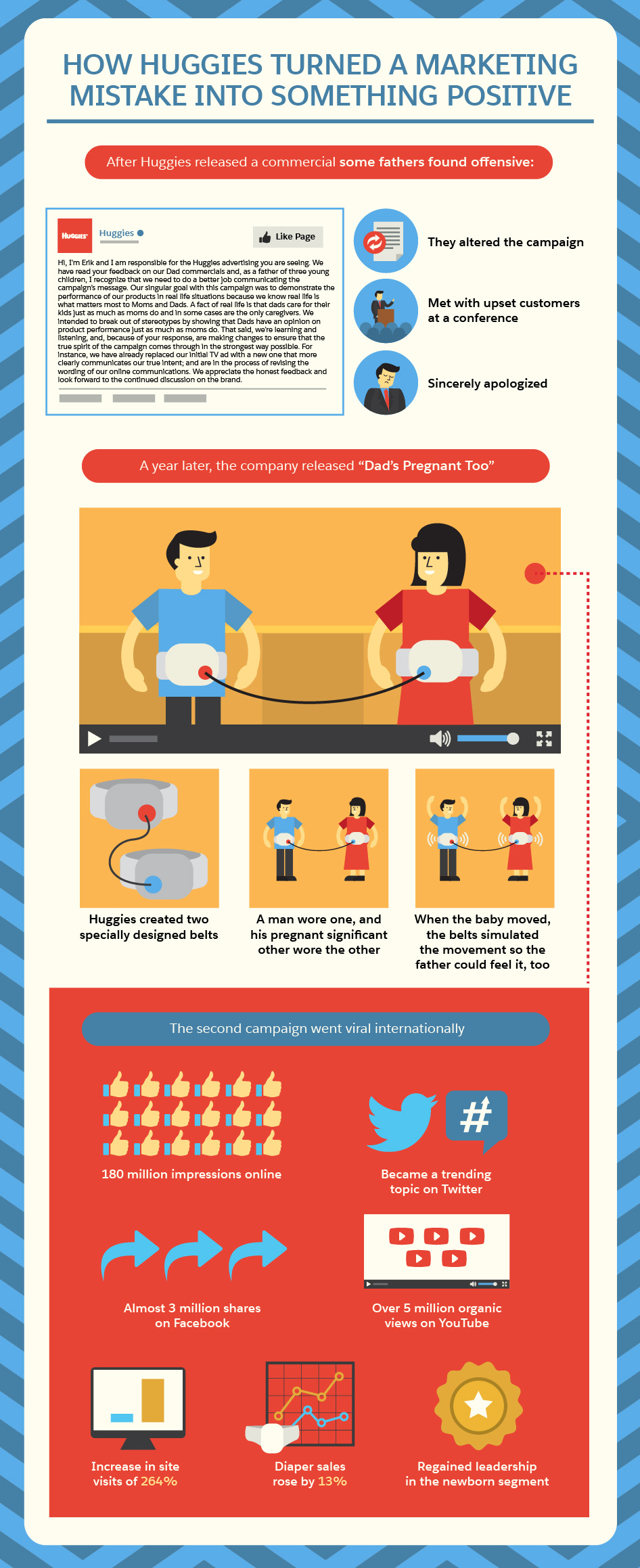
One example of a company that experienced this is Huggies, who, despite the issue, rebounded and found success. In 2012 it experienced a backlash after releasing a commercial called “Dad Test,” which portrayed fathers in what was perceived as a negative light. After consumer complaints, Huggies altered the campaign, met with angry fathers at the Dad 2.0 Summit, and issued an apology on its Facebook page.
A year later, Huggies made international news after its “Dad’s Pregnant Too” campaign, which featured men and their pregnant significant others wearing specially designed belts that let them feel when their baby moved. It was estimated that the campaign reached 180 million online readers. It became a trending topic on Twitter, got almost 3 million shares on Facebook, and had over 5 million organic views on YouTube. Huggies saw an increase in site visits of 264 per cent. Diaper sales grew by 13 per cent and the company “regained leadership in the newborn segment.” Huggies’ new point of view? “Nothing compares to the feeling of being a father.”
No matter the faux pas, it’s important to take customer’s concerns into serious consideration. Even if it wasn’t the company’s intention to insult or hurt feelings, what matters most is how the customers feel.
In order to fix insensitive messaging, remove the product or advertisement. Many companies send a donation to a related organization. However, to ensure the donation wasn’t made just to quiet complaints, a sincere, heartfelt apology for the mistake on the company’s blog and/or social media can show customers that the company has learned from their mistake. Outlining steps or processes to ensure that it won’t happen again can also help restore customer faith in a product.

Groan-Worthy or Cheesy Marketing

It can happen to any company: marketing that crosses the line into cheesy. Or a tagline that is meant to be serious isn’t taken that way. While this isn’t a mistake as much as an unfortunate circumstance, it provides the opportunity to take something that was misconstrued, and has grown into something bigger or different than you expected, and make it work in your marketing mix.
For instance, something as nuanced as the way a person says a phrase in your commercial can catch on and turn into an internet wildfire. MailChimp experienced just that with its famous ad that plays before every Serial podcast episode. The ad was meant to poke fun at the way people pronounce MailChimp’s name, but neither theSerial producers nor MailChimp were expecting so many people to embrace it as a part of pop culture.
If someone takes your advertising and turns it into a joke or meme, if possible, it’s best to take it as a compliment, not an insult. The companies that are best at connecting with their customers embrace how their user base feels about their marketing. In MailChimp’s case, not only did the company keep the ad unchanged for the second season of Serial, they also created several memes on Instagram and other social media profiles that embraced users’ questions and jokes about the ad. This is a good example of a way to handle a critique of your company’s marketing or advertising campaigns.
State Farm’s “Jake From State Farm” commercial has also become something more than its marketing department could ever have expected. It has turned into a pop culture phenomenon, with memes and parodies on platforms like FunnyorDie, YouTube, and Vine. While the commercial was obviously intended to be funny, State Farm has embraced the audience making it their own through parodies. It even maintains activeTwitter and Instagram accounts for “Jake From State Farm” that uses the same kind of voice and humor that people have taken from the commercial. While State Farm may have not anticipated becoming the object of jokes and parodies, the fact that they weren’t defensive, and instead embraced how their customers took the message, made all the difference.
Accepting and going with your customers’ feelings about your products, marketing, and advertising is crucial to fixing any faux pas that might happen. Even if the message wasn’t created to offend, or the typo just wasn’t caught, being honest and upfront, and owning the situation can turn even the most critical consumer into a long-term, loyal customer.
To view the original article Click Here

Friday, 14 November 2014

Burn Your Marketing Plans To The Ground

Okay, maybe burning all of your plans to the ground is a bit dramatic; however, this is the perfect time of year to consider striking a match or two. 2015 is staring us squarely in the face, and we’re all busy looking back at 2014, planning for the coming year, and (hopefully) crunching all of the data we can get our hands on. My hope is that your brand performed well above average this year and has some really big wins to report on. However, I urge you to take a long pause before simply modifying last year’s plans, copying/pasting those KPIs, or leaning back. This is not the time to take a break; it’s the time to break…everything. Light it up, and burn it down. Why?

Because you’re missing the big picture
keep-calm-and-burn-it-down-36

Last weekend, my wife made a simple request: move the toys out of the living room. By the time the sun had risen on Monday morning, I had completely rearranged three rooms, filled up my garbage and recycling twice, and had moved my entire office across the house. Why? Because of the bigger picture. Too often, we pick up junk and move it from one place to another. We hide things under the couch or in a closet, temporarily solving the problem at hand. However, we are obviously creating, then delaying, a much larger headache. And we play this game inside our teams all of the time. We play hide-the-problem, pass-the-blame, and we’ll-deal-with-it-later. Stop. If proving ROI is the problem, don’t hide that headache; fix your data, shift your perspective, and start zooming out. (And if proving ROI is a problem you are having, SME Digital can totally help you out.) If misunderstanding the customer journey is your problem (and you might not yet realize that it is), take the time to understand your customer’s journey and find the right places to fit into it. If your marketing plan is Lego’d together so that you can’t even see the gaps and misaligned pieces, don’t keep building and hope for the best. Step back, readjust your seat, take a deep breath, and strike the match.

Because you’ll create something better

How many times have we typed something up on our computers, just to have it disappear due to any number of technological issues? It’s the worst. But after many screams, curses, and tears, we set out to write it again. And nine times out of ten, the new version is better. Burning something to the ground, whether intentionally or not, give us the opportunity to rethink, reexamine, reorganize, and re-communicate. It’s hard to know what you’re thinking and how your plan will fit together until you have everything in place the first time. Once the sticky notes are done, once the pieces have been handed in, that’s not the end; it’s just the beginning. And facing that reality is hard. Very hard. But if we recognize that starting from scratch will ultimately produce higher quality work, a more organized plan, and be supported by clearer thinking, why do we settle for second (or third or fourth) best? Because we’re not willing to do the work. And if we’re not willing to do the work, can we really expect to succeed? Do the work.

Because it’s hard

I’m not going to lie; burning your work is incredibly difficult. I spent weeks sweating over a graphic for a client that just wasn’t working. I tweaked and tweaked and tweaked, but ultimately there was no other option than hitting ⌘N and starting from scratch. But what was the alternative? A poor product, an un-WOWed client, and nothing but a checkmark to show for the work. Be willing to start over because the easy path – copying over KPIs, tweaking old objectives/strategies, plugging in half-thought-out tactics that will be fleshed out later – is actually more work in the long run. Sure, you have completed the task, but you have also set yourself up for more meetings, confusion, and misdirection later. Why? Because a weak structure will always provide weak results. Burn your marketing plans to the ground, do the hard work, and create something that is a WOW. Though it is no fun to watch your work burn, it is incredibly rewarding to watch what rises from the ashes.
To view the original article Click Here

Thursday, 7 August 2014

6 Mistakes Many Marketers Make Daily

It used to be that "multi-channel marketing" meant ensuring that your print, TV and radio ads looked and sounded the same. Now, consumers have more channels than ever to interact with your brand, so creating an integrated marketing experience means getting everything right, from social to search, automation to analytics, and lead nurturing to LinkedIn.
Simply put, you can no longer afford to focus on one element of your marketing and put the rest out to pasture. Your prospects, customers and leads expect a fully integrated experience with your brand, and if your company doesn't provide one, your competitors will. Below are six mistakes most marketers make daily, and some suggestions on how to address them.

1. Marketing without a content strategy (or with a boring one)

If the mantra for veteran salespeople was "always be closing," the modern day equivalent for marketers is "always be publishing." As David Meerman Scott is fond of saying, "On the web, you are what you publish," so brands without a digital content strategy are already playing catch-up. Typically, the biggest hurdles for marketers without a content plan are a lack of inspiration (my industry is boring, no one will read the content) or a lack of resources. But you don't need a large team of writers to create a thriving content strategy: What you really need is a focused commitment to give your prospects, leads and customers content they can't get elsewhere. Need inspiration? Check out GE’s Pinterest page, the Zappos blog, Aaron Levie’s Twitter account or GrubHub’s Facebook page. All of them are a great reminder to all of us that your content, regardless of your industry and company size, doesn’t have to be boring or Hollywood-production levels to be effective.

2. Offering content without context

Some brands have a content strategy, but they are playing to an empty room because they don’t know anything about their audience. Case in point: A recent Razorfish study estimates that just 38% of marketers can segment prospects from existing customers for targeted marketing. There are few things more annoying to customers than being sold products they've already purchased, so instead of being tone-deaf, use tools and technology to inform how you market to people at every stage of the funnel. This can start small (with different calls to action based on the person’s lifecycle stage), but eventually it should include your entire web strategy so that every piece of content you show a prospect is infused with context for their interactions with your brand to date. Amazon, of course, has built a business on this concept, but the lesson holds true for all of us — matching content plus context is the secret sauce for a more personalized and lovable web experience for your customers.

3. Thinking slow and steady wins the race

In marketing, speed is a feature. If a website takes longer than three seconds to load, 40% of people will abandon the site. But the headache doesn't stop there.  Slow sites also rank lower in search, meaning that people may never even find your site even if you have a great keyword strategy in place.This blog post from Greg Linden is from 2006, and even then researchers at both Google and Amazon found that half a second in load time could significantly impact everything from bounce rates to revenue numbers. If that was the case in 2006, imagine the impact it could have on your business now, in a world where we are far more connected than ever. Yottaa provides a free website speed test on its homepage to gauge your current performance, so start there, then test how your site responds on tablets, mobile and other devices. Most importantly, instead of thinking of a slow-loading massive banner image or additional lines of code running on your site as minor nuisance, think of time as money, because in the marketing world, it truly is.

4. Talking (or tweeting) about yourself non-stop

brandingtwitter

IMAGE: MASHABLE COMPOSITE, TWITTER, GETTY CREATIVE, MARTIN951, JOHAVEL, OWL_LEE, ALEKSANDR-MANSUROV-RU
We all hate it when a fellow guest at a cocktail party talks ad nauseum about their own work, life and hobbies without taking any interest in the rest of the group. And yet, when it comes to social media, marketers assume consumers want to hear about the company non-stop: That’s simply not the case. The best brands invest 70-80% of time discussing content that helps their core audience live, work or play better — only the remaining 20-30% is about their product or service. When it comes to social media specifically, 
Spend as much time listening as you do talking. Monitor what your customers are saying about their experiences, when they are interacting with your brand the most, and what types of content inspires the best conversations and social shares, then adapt accordingly.

5. Not knowing your numbers

Marketing used to be considered "arts and crafts" by senior executives, so knowing your numbers can not only determine the success as a company, but also your career as a marketer. If LTV, CAC, marketing-originated customer percentage, and time to payback sound like Latin to you, it’s time to brush off your math skills and put them to work. This primer is a good way to think about getting started, but to be honest, that should be just the beginning. You should know what your conversion rates look like for traffic to your site, conduct A/B tests regularly to gauge what’s working and what isn't, and create monthly targets for your team that are metrics-focused. Gone are the days where "impressions" or "positive sentiment" carry the day for marketers: Your CEO can't pay the bills with those. Your marketing efforts should impact your business and your bottom line, and the only way to prove that it does is by knowing your numbers and leveraging them to improve your efforts constantly.

6. Death by word count

The average adult attention span is 2.8 seconds, barely long enough to read a tweet, let alone absorb your 210 page ebook. To that end, create a content strategy that matches the way people actually consume content: Quickly, often and with a bias toward all things visual. With 90% of the information transmitted to your brain being visual, you can better your brand by spending more time showing people what you do, instead of simply telling them. This tenet is not relegated to your website, but also to your social channels: Highly visual content isn’t just more digestible, it’s also significantly more shareable.
The way people shop and buy has changed dramatically over the last decade. Whether you have a short period of time to engage a prospect or a limited window to impress your executive team, the six mistakes above are common pitfalls that often trip up even the best of marketers. As the late great Notorious BIG said, "things done changed." It’s about time marketers do too.
To view the original article Click Here