Showing posts with label viral marketing. Show all posts

Tuesday, 24 January 2017

How 3 Social Superstars Built Huge Followings Fast

How 3 Social Superstars Built Huge Followings Fast
Bodyguards, supercars, models, playboy mansions, helicopters, private jets, and "baller" lifestyles. Sound like a movie—or the dream of every 16-year-old teenage male? Think again. These are part of the daily social media feeds from the biggest players on the planet.
We sat down with three social superstars: investor and entrepreneurship guru Tai Lopez (who has built an eight-figure online empire); international sales expert and New York Times bestselling author Grant Cardone (who has built a nine-figure real estate empire); and “supercar” lifestyle vlogger Mr JWW (who has built a successful apparel company and owns cars we are jealous of).
Here is how they built mega social media followings—fast.
What was the top strategy you used for building followers quick on Facebook, Instagram and Snapchat?
Tai Lopez (TL): When marketing, I use the PVP Formula: product, virality and paid. As the billionaire Charlie Munger said, “You can’t polish a turd.” You first have to market a quality product. (Apple is a titan company because the iPhone is a remarkable device.)
For virality, you have to employ controversy, humor and drama in your marketing. (There’s a good book about it.) Look at the Kardashians and Justin Bieber: they evoke strong emotions in people and go viral. Once you have a hit product that’s going viral, invest in paid boosting. You’re not buying your way into the market; you’re just boosting existing momentum.
You need a different strategy for each social channel. Twitter is high-frequency posting. Snapchat is like a TV show. Instagram is a museum showcase of your highlights. YouTube allows for long-form content. And Facebook is a hybrid of them all. Apply the PVP formula in the proper format and frequency for each channel and you’ll get huge results.
Grant Cardone (GC): I didn’t try to build my following fast; it felt like forever to get my first 100 followers. But I willingly posted ALL of my content, freely and frequently. My people said, “Grant, you’re giving away too much.” They didn’t realize how much content I had; it allows me to post up to 50 Snapchats, 100 Tweets, 18 Facebook posts and four Instagram posts every single day on multiple topics to particular audiences.
Mr. JWW (JW): Content can be tricky, so you have to be passionate about what you're doing—it's scary how anything forced or dishonest is amplified through the camera. My YouTube and Instagram subscribers exploded when I evolved my production quality. Most YouTube content is pretty amateur. It sounds simple, but a little investment in image and sound quality goes a long way to elevating your content to high-end amateur quality. YouTube has evolved into a serious contender for entertainment alongside commercial TV. Competition has grown and viewers expect higher quality content.
What’s your strategy for continuing to grow followers? Has it changed since the early days when you were first building it up?
TL
: Rather than changing too much, I master the fundamentals. Because of the results I’ve seen, I devote more marketing budget to social media—but my strategy hasn’t changed since the early days. It’s like basketball: what works, works. You put the ball in the basket and play defense. Although little nuances continually arise, a great 1970s basketball team would compete fine today. Likewise, a great 1970s marketing strategy would work well today. Look at some of the David Ogilvy marketing campaigns.
GC: I post content frequently. Every day I deliver something on money, investing, sales, marketing, promotion, branding, negotiating, closing the sale, follow up, motivation, phone sales, cold calls, network marketing, startups and real estate investing.
I constantly look to dominate new platforms. For example, my employees said, “Grant, your customers aren’t on Snapchat.” I replied, “If people are there, they’re my customers.” I show my millions of followers the “behind-the-scenes” of my life. This can include my marriage, life as a father, my spirituality, or going to monster events like the World Series or a Conor McGregor fight.
JW: I had zero subscribers when posting early videos; they were just "test content." I had never uploaded a YouTube video and I wanted to know what the platform was about before committing. Go back to the beginning of my channel and there’s no talking or face on camera, just really short clips compared to what I do now.
What’s something that saved you time when building your following?
TL
: The billionaire Charlie Munger says, “Be a perpetual learning machine.” I read a lot and try to learn from everybody—ranging from the Kardashians to people you’ve never heard of. Social media is cool because you can study what’s clearly winning. It’s not a confidential business plan. It’s apparent what a person attracting a trillion likes does differently to someone scraping five likes.
Social media is cool because you can study what’s clearly winning. — Tai Lopez
GC: For four years, I handled all my social myself. No one posted anything without my approval. That was good and bad. I learned how it worked, but not delegating made me go slower than necessary. Today, two of my people facilitate posts, set up automation, help me with graphics, do branding and expand posts into articles—but I’m still the creator and responder. So, ask me a question on Snapchat, and it’s me who answers. (Every day I answer about 400 Snapchats and tweets.)
What kind of content gets the most engagement?
TL
: Aspirational lifestyle stuff gets a lot of engagement—Lamborghinis, jets, helicopters, big houses. But “rants” about “what’s wrong with the system” get the most engagement.
GC: I schedule a daily live stream—no exception. I go wide to continually expand my audience. Monday is real estate. Tuesday a book review. Wednesday is on marriage and business. Thursday is sales, startups and young entrepreneurs. Friday is finance and money. Saturday and Sunday are Ask Me Anything. While everyone seems to avoid politics, I picked up more Twitter followers during the 2016 U.S. presidential election because of my strong stance.
What was your biggest social media mistake?
TL
: Going too slow. No one was teaching this stuff five years ago. Not many people know how to do social media well, really. Plenty of people write books and articles, but it’s harder to do than teach.
GC: I've made so many mistakes—underestimating how powerful the platforms are; not going bigger, faster, sooner; not posting more frequently than I already do; not subtitling; not getting on Snapchat from the get-go.
My biggest mistake was getting too fond of one platform. I’d get lazy in not taking the time to figure out the tone, personality and needs of each platform. I’ve not transcribed my content in multiple languages. I don’t spend enough on boosting Facebook ads.
Tai, your Snapchat is like a soap opera, usually involving models, cars and crazy experiences. Can you tell us about the strategy?
TL: Forget the word, “social.” The operative word is “media.” Social is a new trend. The old trend has been going for over a century. Humans are addicted to mass media. It started as books, evolved into radio, movies with no talking, then movies with talking. Soon it’ll be virtual reality. To build great media with an engaged audience, pretend you’re making a blockbuster show.
My social media goes viral because it’s authentic. People once thought that I rented fast cars and a one-time set to make it look like I lived in a cool place. Snapchat beautifully exposes the truth. You can’t fake days, months and years of daily Snapchat content. Do social media longer and people feel part of your life. As people become addicted to your social media, you have permission to occasionally blend in some marketing of your products. Most people just push products on social media—that’s a real mistake because they don’t have the engagement.

Friday, 26 February 2016

The Secret Sauce That Made These 7 Blog Posts Go Viral

The Secret Sauce That Made These 7 Blog Posts Go Viral
Admit it…
You dream of going viral.
In fact, the thought of writing a post that blows up on social media is what motivates you to keep blogging.
After all, one viral blog post can turn an obscure blogger into an internet celebrity in a matter of days.
But how do you make it happen?
One way is to keep writing and hope that one day the viral gods decide it’s finally your turn.
Good luck with that.
An altogether smarter way is to look at posts that have already hit the big time, and see what they have that yours don’t.
If you want to discover the secret sauce that’ll send your writing through the roof, you need look no further than the following posts.

Viral Post #1: Marriage Isn’t For You

This article is the real deal: aside from the fact that it has received over 1.8 million shares on Facebook, it has also been featured on The Huffington Post, BuzzFeed, MailOnline,Cosmopolitan, MSN.com, Yahoo.com, The Matt Walsh Blog, Deseret News, Today.com, The Today SHOW, KSL News, TheBlaze, and Fox & Friends.
The post’s author, Seth Adam Smith, has made several appearances on national television and has even landed a book deal as a result of the popularity of his message.
If you’re one of the few remaining humans who haven’t read it, it’s essentially about how society has got marriage somewhat backwards – that if we were all a bit less selfish, we might have better marriages.
Why did this resonate with so many people? Let’s take a look.

It Evokes Curiosity Using Surprise

First of all, the post has a great title. It makes you curious.
You think, “What’s the deal with this guy?”
“Is he a commitment-phobe?”
“Is this just shameless clickbait?”
And maybe even…
“How dare he! Marriage is for everyone. What a selfish jerk!”
But then you click the headline anyway. Because it provoked a reaction and it got you thinking. Your curiosity demanded to be satisfied.

It Makes a Statement That Readers Want to Support

This is a biggie when it comes to hitting it big-time with a blog post, because the psychology ofsocial sharing is pretty straightforward – if the content makes us look good, we’re much more likely to share it.
In this case, despite the provocative headline, the take-home message of the post is actually, “Marriage isn’t about you, it’s about giving of yourself to someone else.” And this acts as a strong motivator for social sharing. Sharing this post makes a clear and positive statement about the sharer.
Sharing the post is another way of saying to people: “I believe in unselfishness.” It’s also an easy way to give a gift – the gift of happiness – and giving makes us look generous.
Whatever the exact motivation, sharers perceived that the post would reflect well on them, so they shared it.
Want some of this secret sauce? Consider this question:
What could you create that might make those who shared it look good to their peers?

Viral Post #2: How to Crack a WiFi Network’s WEP Password With BackTrack

With 4.8 million shares, this post by Gina Trapani tops the list of the most viral posts ever published on the Lifehacker blog. It didn’t create the kind of media buzz the former post created, but it went viral for quite different reasons.
Gina’s post isn’t nearly as emotionally charged as the first example; it’s really just a tutorial. Sure, the fact that it’s about hacking into someone else’s WiFi connection could create a bit of controversy, but when comparing this to “Marriage Isn’t For You,” it’s not hard to guess which was the more newsworthy.
So how can two such different posts both get such incredible results? Well, this post simply had a very different (but equally effective) flavor of secret sauce.

It Tempts Us into Murky Waters

There’s something not entirely legitimate about cracking someone’s password, and most people are at least a little curious about activities that are ethically dubious.
Just reading this post could make some readers feel like cyber-bandits operating on the fringes of society, and that’s exciting.
Even if you don’t use the advice to get free Wifi, it’s kinda cool to know how, right? After all, you never know when you might need it, right?
Making readers feel a little rebellious is a great thing for your viral coefficient. People love to share insider tips like this one, especially when it makes them feel like they’re getting away with something that’s frowned upon, but not necessarily illegal.
Of course, when sharing they can take the moral high ground by implying, “Of course I’d never do this, but just in case you would, here’s the info.” But the point is that they still share.
Bottom line? People love to be the first to hear a secret, but the real fun starts when they can show that fact off to their friends.

It Solves an Interesting Problem (Before Anyone Else)

It really does pay to be the first person to solve (or highlight the solution to) a very specific problem. In this case, enough people wanted to crack WiFi passwords to get this post off to a good start.
And of course it helps to share your secret on a site that already has a huge audience. But not every post on Lifehacker (or any other big blog) goes viral, so the topic was the key.
Here’s where the secret sauce helps again. If you can solve a problem a big blog’s readers are desperate to solve (or didn’t even know could be solved), landing a post on that blog should be a breeze.
Want some of this secret sauce? Consider these questions:
What specific problem could you solve that no one else is addressing yet?
How can you make your readers feel like they’ve got the inside track on something (just a little bit) edgy?
Which blogs already attract the people who are most likely to share your idea?

Viral Post #3: Content Is King Myth: Debunked

Derek Halpern of Social Triggers cites this as one of his most popular posts, and it has attracted nearly 2,000 social shares. It contains some great lessons for bloggers, too.
When he published the post, “content is king” was (and still is, in fact) one of the biggest buzz phrases in the marketing community, so he cleverly piggybacked onto a conversation that was already happening.
In fact, Derek took advantage of several key “secret sauce” ingredients.
Here’s how…

It Puts the Cat Among the Pigeons

Derek deliberately took a controversial stance on a hot topic.
However, his post wasn’t just a shallow attempt at a contrarian view. Derek’s post stole the spotlight by using academic research to prove a contrasting point: that according to the study he cited, design actually wears the crown when it comes to building credibility.
Controversy always attracts attention, and when a controversial view turns out to have a solid basis, it’s a powerful cocktail for virality.

It Makes Sharers Look Like Thought Leaders

As we saw with our first viral example, blog posts get shared more when they make the sharer look good. This one provides a different way to look good: thought leadership.
By sharing a post like this, people are seen as being part of a thought leadership movement, and some of that cleverness reflects back on them.
So when someone publishes a piece that could make us look like we’ve got the inside scoop while our competitors are missing the boat, we’re pleased as punch to add it to our social calendars.

It Enables “Slipstream” Promotion

This post wasn’t written on a whim. Derek knew exactly what he was doing when picking his topic, and he already had one eye on how the final post would be promoted. He calls it the “drafting” technique and it’s based on a pretty great sports metaphor that explains how it worked.
In a bike race, competitors will often “draft,” or ride close behind or beside those they’re trying to beat, in a space called the “slipstream”. Aerodynamically, this gives them an advantage because it puts to use the momentum created by the person in front.
Similarly, Derek was strategic about his outreach when it came to promoting this post. He researched publishers who had written on the “content is king” subject and emailed them to let them know that he had found some research that proved a contrasting point.
In doing so, he was able to capitalize on the existing momentum of the subject matter. Pretty brilliant, right?
Want some of this secret sauce? Consider these questions:
What are people already talking about in your niche?
What new insight can you bring to the conversation?
How can you integrate the drafting technique into your promotion strategy?

Viral Post #4: Here’s a Quick Way to Get More Likes On Your Facebook Page

Rapidly approaching 3k social shares, this post by Scott Ayres from the PostPlanner blog is no slouch.
Like some of the other posts mentioned here, long-tail SEO (targeting longer, more specific search queries like “how to get more likes on my Facebook page”) has certainly contributed to its success.
However, this post has a few other great “secret sauce” ingredients that have sweetened the deal for its readers.

It Harnesses the Power of Visual Content

Infographics (the good ones, at least) get shared like crazy because people love visual content as an antidote to long blocks of text.
The attractive, professional-looking infographic which accompanies this post makes for the perfect addition to the social media queue for a massive and content-hungry audience: anyone who wants a little more attention on Facebook.
But while infographics can do well on social media, not all go viral. So what’s the difference between this and other infographics that were less successful?
In this case, a major contributor was likely the broad appeal. Almost anyone who’s active online, regardless of their niche, will be interested in building a larger Facebook following.
Though it’s true that niche-specific content can still go viral, in this case mass appeal coupled with great design definitely worked in PostPlanner’s favor.

It Promises to Be Quick

Nobody wants to waste their time.
We’ve all got cat videos to get back to, for heaven’s sakes!
The use of the word “quick” in the title of this post reassures potential readers that clicking won’t send them down a time-draining rabbit hole.
It essentially says, “Don’t worry, you’ll be back to your news feed momentarily.”
The pairing in the headline of “quick” with a strong benefit like “more Facebook likes” is a winning combination. Not only can the reader determine right away that by reading they’ll learn something of value, but they also determine that they’ll be able to learn it without losing too much time.
Want some of this secret sauce? Consider this question:
How can you assure your readers that they won’t have to sift through thousands of superfluous musings in order to get the solution you promise in your headline?

Viral Post #5: Color Psychology in Marketing

Julie Neidlinger, the author of this post published at CoSchedule, credits the opposite of “quick” for its success, noting that the site’s long, meaty, in-depth content has historically garnered many shares.
Furthermore, CoSchedule noted, “During the past year, this post has steadily grown (not waned) in traffic and shares, making it the #2 result for ‘color psychology marketing.’ That means that once you reach a tipping point, your momentum increases. Additionally, overall Pinterest traffic to the CoSchedule site is increasing (more than 15,000 pageviews) due to this post alone.”

It Fuses Ideas to Make a Unique Topic

This topic effectively combines color theory, psychology and marketing – three topics you wouldn’t normally expect to find together.
But the result is a highly distinctive post with great practical benefit, perfect for anyone who’s ever wondered, “What colors should I use in my design?”
The inclusion of psychology is a stroke of genius, too, because readers love the idea of using scientifically backed information to get better results.

It Dives Deep into Detail

Although its title doesn’t claim to be so, it’s likely that many sharers view this post to be an “ultimate guide” of sorts on the subject of color psychology in marketing. Something of a niche-y subject, color psychology makes for an interesting and valuable topic to cover.
Length alone, of course, isn’t enough to make a post great. This post sets itself apart by being chock-full of helpful insights, not fluff.
The post is really valuable not just because it’s long, but because it’s so clear and understandable.
This post will likely reign for some time as another writer would find it tough to beat.
Want some of this secret sauce? Consider these questions:
What unexpected combination of topics could you use in your next post?
What specific problem could you create an in-depth resource to solve?

Viral Post #6: 29 Life Lessons Learned in Traveling the World

Benny Lewis’ blog is pretty unassuming. To look at it, you might never guess that it has a  post whose share count blows even some of those mentioned here right out of the water, including more than 53k shares on Facebook alone!
What is it about his post that allowed him to make such an impact?

It Uses Videos to Heighten the Emotional Connection

Embedded video, when carefully chosen, can add virality to a post, helping us to engage on an emotional level. The more a post resonates with us emotionally, the more likely we are to share it. And there’s nothing like seeing a person on screen and hearing them speak to forge that emotional connection.
This post has three embedded videos, but only one was created by the author himself (which attracted over 250K views on YouTube). The others are just great videos that made sense with the subject matter, each with its own inherent value. Any video can help your post engage with more of the reader’s senses.
Was video the only thing that made readers connect with this post on an emotional level?
Definitely not. The 29 life lessons he outlines in the post certainly play a huge part in why thepost went viral – who doesn’t want to learn more about life?
That said, the videos helped to lift what would otherwise have been a less interesting and engaging post. And arguably the main video is an even bigger viral success than the post itself.

It’s Not Afraid to Tell Readers What to Do

Another brilliant stroke that contributed to this post’s success was the fact that Benny specifically asks his readers to share his video on their Facebook walls.
He gives them crystal-clear instructions at the top of his post, instead of waiting until the end of the post, which many bloggers do.
It’s always wise to explain clearly the next step you want your reader to take, because the more readers have to guess, the less likely they are to take the action you desire.
Want some of this secret sauce? Consider these questions:
How can you help your readers have an emotional connection with your content?
Once they’ve made that connection, how can you more clearly guide them to the next step you want them to take?

Viral Post #7: Social Media Strategy in 8 Steps

This post by Jay Baer has been cited as one of the most successful posts on the Convince and Convert blog.
With 860 shares on Facebook, 578 on LinkedIn and 366 on Google+, this post must have some secret sauce, right?
Let’s see what it is.

It Makes Readers an Offer They Can’t Refuse

You’ll have heard a hundred times that headlines make all the difference. But in this case, was Jay’s headline particularly clever or sensational? Nope, not at all.
But it was straightforward.  And sometimes that’s all that matters.
Lots of people want an effective social media strategy. Some people’s jobs depend on being able to create one. This headline promises to lay it all out in just a few steps.
If the benefit is appealing enough, your headline doesn’t have to be showy, just clear.

It Leverages the Power of an Established Platform

Just as Benny’s post used a video to tap into a huge pre-existing audience (in his case, on YouTube), this post does the same with LinkedIn’s SlideShare platform.
In fact, many of Convince and Convert’s most popular posts have embedded SlideShare presentations, a fact that they feel is a major contributor to their success.
Repurposing your existing content for other platforms gives you the opportunity to draw in readers from a variety of locations, not to mention to appeal to a wider variety of content consumers.
Jay’s SlideShare presentation has over 400K views, and if even a small portion of those readers had enough interest to click through and read the original post, it would be well on its way to blog stardom.

It Shows That Bigger Isn’t Always Better

Unlike other posts on this list, this one is not epic in scale. In fact, it’s just 600 words in length.
In this case that works in its favor – this post is just about as “snackable” as they come. Each of the eight steps mentioned in the title only amounts to a paragraph of explanation.
Short-form posts can be successful simply because they’re easy to read, which means that readers are less likely to give up before they get to the meat of the post.
Conventional wisdom may encourage more long-form content, but experiment with both to see which is more popular with your audience.
To view the original article Click Here
Want some of this secret sauce? Consider these questions:
How can you make your readers a simple promise that they won’t be able to refuse?
How can you leverage the power of an existing platform to get across your message?

Do You Have What It Takes to Go Viral?

Going viral can seem like a distant dream.
But if you really want a chance to hit the big time, you need to stop dreaming and start doing something different.
So use these examples for inspiration and add some secret sauce to your next post.
Make it surprising. Or controversial. Or visually stunning.
Make it distinctive and engaging and impossible to resist.
And some day soon you’ll wake up and find that viral hit…wasn’t just a dream.

Thursday, 17 December 2015

How To Go Viral: Lessons From The Most Shared Content of 2015


sumo-newsreader
What content were you reading this year? Did it include some of the most shared articles of 2015?
Why does certain content get shared so much and go viral? Last year we looked at 100m posts and highlighted the 
common characteristics of viral content. This year we added over 1 billion articles to our content database and looked again at the most shared posts. Our analysis shows that viral posts remain outliers, and unfortunately there is no magic formula to go viral.
However, there are insights from viral content that we can use to improve the shareability and engagement of our own content. The posts we are looking at in this review are primarily consumer posts, we have previously examined the best B2B posts of 2015.
Below we have provided examples of the most shared posts of 2015 and tried to break down why they went viral. If you haven’t got time to review them individually, you can jump straight to our conclusions.
Our review has identified four different elements which occur frequently with viral content. A combination of these elements may not guarantee viral success but they can improve shareability. Look out for these elements in each of the viral posts below.
viral-elements

Viral Posts Are Insightful Outliers

Viral posts are not the norm. Our examples below include posts with millions of shares. However, these viral posts are exceptional even for very largest viral sites, as we can see from the graphs below. These show the distribution of shares across posts for BuzzFeed and the New York Times. buzzfeed-nytimes
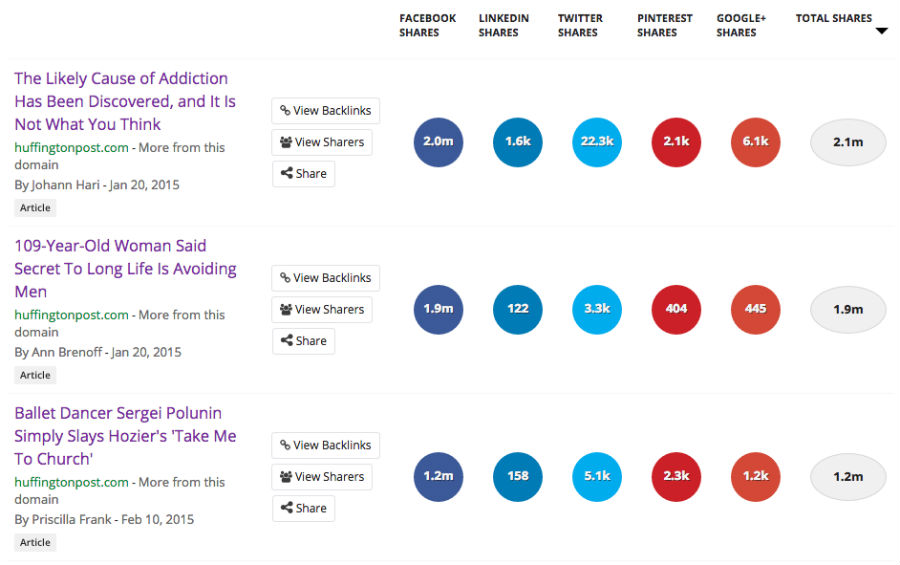
There are fewer and fewer posts as the numbers of shares increase. Going viral is like alchemy, and even the best sites cannot consistently replicate the success of their top posts  (if they could, they would). Like most publishers, the top sites have a lot of steady performing content and a few huge hits. The top three most shared articles on the Huffington Post demonstrate this quite clearly as we can see below. The top post got almost double the shares of the third most shared post. This is a pattern we see again and again.
huuf_post-top_3
Thus viral posts are exceptional, and there is no simple formula for viral success–unless possibly you are an international celebrity. For our analysis we excluded content about and from celebrities, musicians and films, even though they can drive huge volumes of traffic. For example, Adele’s recent release of her song Helllo on YouTube raced quickly past 500m views.
adele
What if you’re not Adele? (and If you are Adele: Hello, how are you, please feel free to share this post). What can you do to create more shareable content?
In our view these viral posts provide insights into how we might make our own content more shareable, even if it doesn’t go viral. Here are our lessons from the most shared content of 2015.

How To Go Viral

1) Surprise People (Facts & Images)

People like to share content–both facts and images–that surprises. They also love to share new research and trends, particularly if they challenge current perceptions. Marketo’s 2013 survey with Brian Carter on why people share on Facebook found that people love to share amazing and surprising content. This view is supported by our review of 2015’s most shared content.
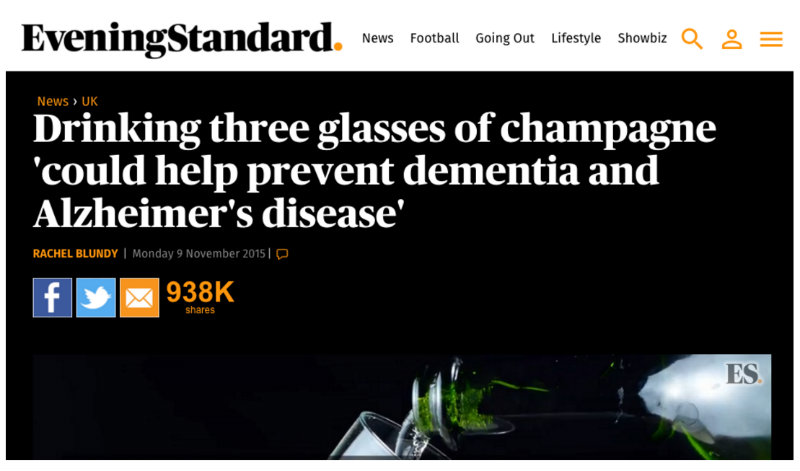
Example: Champagne Prevents Alzheimer’s Disease (938,000 shares)
The most shared content on the London Evening Standard site this year was a post that probably made many of us happy. It highlighted new research showing that champagne can help prevent dementia and Alzheimer’s Disease. Very welcome news at Christmas. Cheers!
standard-champagne

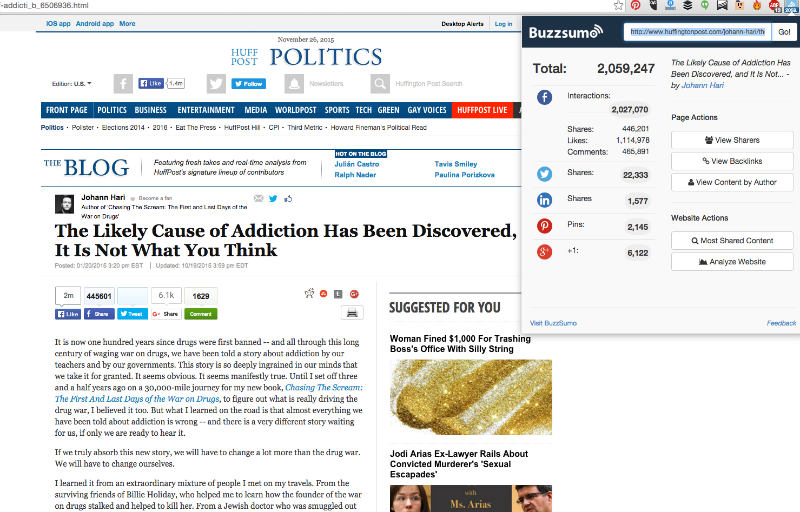
Example: The Cause of Addiction Is Not What You Think (2m shares)
The most shared article on Huffington Post this year was also surprising. It combined research with a provocative title. The post was about addiction, a current topic of discussion and interest. The post highlighted new research challenging the prevailing wisdom about addiction and highlighted the significance of isolation and loneliness. The post was clearly thought-provoking and made people keen to share.
This post went viral on Facebook as we can see below. In most cases we found Facebook was the key network in igniting and driving viral content.
huff-post
(Huff Post missing Twitter share count, which we can see with BuzzSumo Chrome Extension)

A subset of surprising facts is new research and trends. The latest slides from Mary Meeker on Internet Trends are a good example of highly shared B2B content with nearly 3m views. It also helps that they’re in Slideshare format which makes them easy to digest — much easier than a dense report.
Viral Elements – Surprising content backed by research, provocative titles and easy to scan formats.

2) Leverage A Trend, Particularly Zombies

We all know that the trend is our friend. Commenting on, or including, in-vogue topics in your content can increase engagement with your audience. In 2015, if in doubt about popular topics, write a Zombie story.
Example: Zombie-Themed Cruise (1.5m shares)
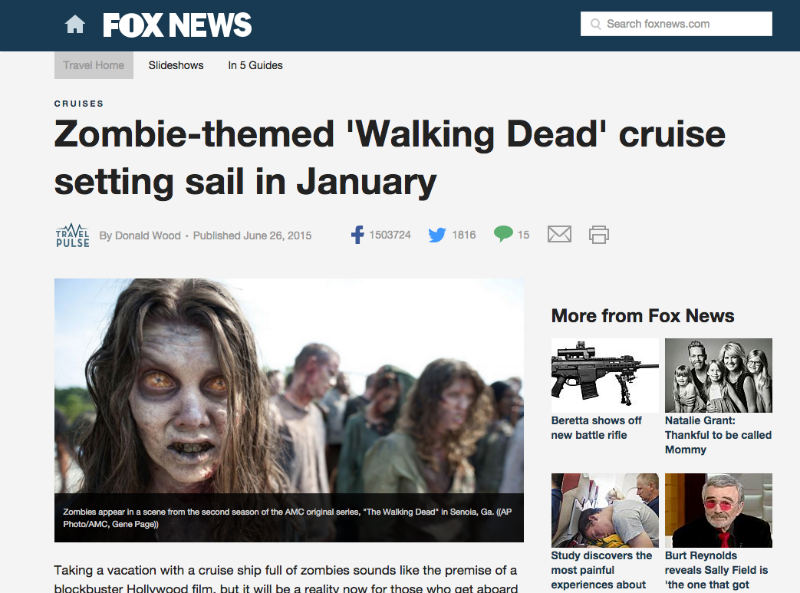
This is an example we would not normally predict to go viral. It is simply an article about a Zombie-themed cruise; however, the reaction was huge. The post got over 400,000 comments. Yep, that is 400,000 comments. It was fun and very much on trend. Who would have thought that Zombies would be viral?
zombie-post
Fox news is a popular site, but this post dominated their other most shared content. It got almost five times the shares of their next most popular articles, demonstrating again that viral posts are outliers. Fox was not able to reproduce this level of sharing with any other posts or even come close to it.
zombie-list
Viral elements: Content about a popular topic or trend. But remember that there’s no guarantee.

3) Inspire People

Inspirational quotes, including images with inspiring text, have become a very popular form of content on the internet. Insipiring content can take many forms, including stories like those below, but there seems to be no shortage of appetite for inspirational quotes.
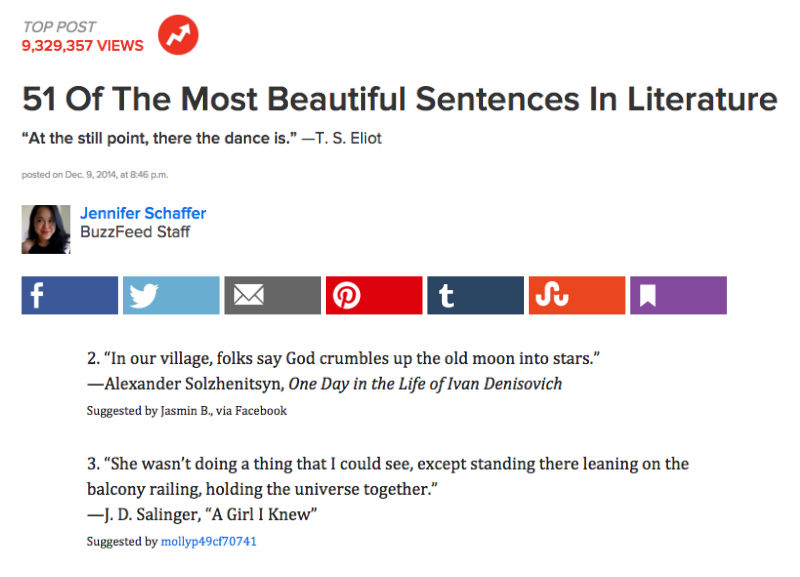
Example: 51 Beautiful Sentences in Literature (1.4m shares)
BuzzFeed remains the master of the curated viral list post. We hate to admit it, but list posts remain one of the most shareable forms of content.
This curation of 51 beautiful literature quotes had over 9m views and over 1.4m shares. Most people have favourite books and quotes.
buzzfeed-quotes
Viral elements: Inspirational quotes, curated content, list format that is easily scannable. And yep, list posts still do very well. Which brings us to:

4) Create Stunning Picture List Posts

We have previously identified picture list posts as an ideal format for viral content. Images are very powerful on the internet and picture list posts enhance this power with the shareability of curation and list posts.
Example: 52 Places To Go In 2015 (522,000 shares)
This was the 4th most shared post on the New York Times this year and achieved over 500k shares. It is a list post with beautiful pictures that appeals to the love of travel and adventure.
ny-post-2

Example: Overpopulation, Overconsumption in Pictures (700,000 shares)
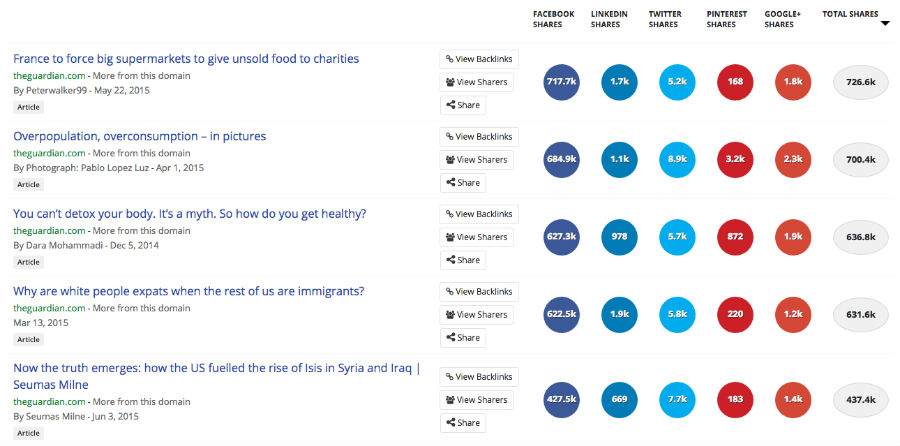
Beautiful images are inherently shareable but photos do not need to be of beautiful things. This series of images on The Guardian demonstrated much that is ugly about the world but did so using very high quality surprising images. Like the earlier example, the post is very surprising, thought-provoking, and visually rich – key viral elements.
guardian-post
This article was the second most shared post on the Guardian this year.
guardian-list
Viral elements:  Visually rich posts with awe-inspiring graphics, and curated list posts.

5) Exploit Cute Animals & Babies

Yes, you read that right. Cat posts have become cliche on the internet. Dress a cute cat in a Halloween outfit and you have the makings of a very shareable post. It is not only cats, other pets and babies do equally well.
Example: This Site Will Make A Stuffed Animal Clone Of Your Pet (683,000 shares)
We took this example from Gizmodo. You might expect to see cat posts do well on big viral sites such as BuzzFeed, but less so on sites such as Gizmodo. However, Gizmodo’s top post this year by some margin was about pets.
stuffed-animal-list
The post received over 680,000 shares.
stuffed-animal-post
Babies are also a good substitute for pets, or is that the other way around?
Viral elements: Cats, dogs, pets and babies. The Gizmodo post was also surprising, or maybe not if you are a pet lover.

6) Be Amusing

People like to share entertaining content. A study by the New York Times found one of the most common reasons people share content is to bring valuable entertaining content to other friends. Make ’em laugh, and you’re on your way to going viral.
Example: Earth Endangered By New Strain Of Fact-Resistant Humans (1.4m Shares)
For example, this amusing post on the New Yorker got twice as many shares as any other post on the site this year. It may have also tapped into a trend about people questioning scientific evidence.
new-yorker-post
n_yorker_list
Example: When You Realise, You’ve Had One Too Many (827,000 shares)
People love to share amusing videos, and video is a fast growing format on Facebook. This short video was one of the top Vines this year with over 56m loops.
vine-video

vine-list

Viral elements: Amusing posts and videos. Our first example leveraged a current issue whilst the second leveraged a cute kid.

7) Be Controversial

Controversy engages people though it carries a degree of risk. By nature controversial posts can be divisive. However, people often share to be part of a tribe supporting a particular view and to show their loyalty or belonging.
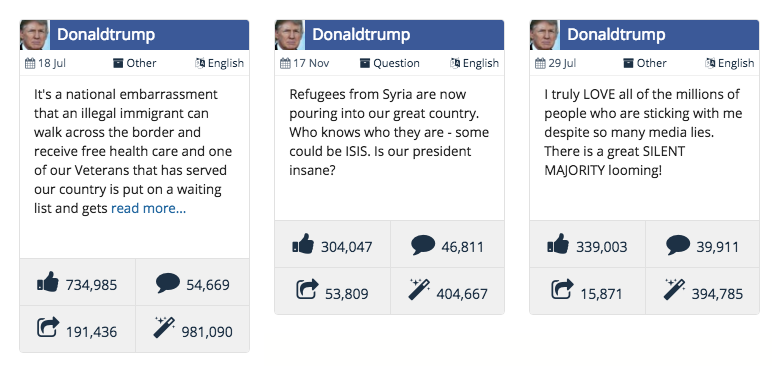
Example: Donald Trump Facebook Posts (millions of interactions)
We had a look at the Facebook posts of Donald Trump and filtered out those with the most engagement using our Facebook Analyzer tool. Donald Trump may be divisive, but he has engaged a tribe with similar views through his posts.
donaldtrump
If we look at the likes and shares of posts on Donald Trump’s Facebook page over the last 6 months, we can see that his controversial statements have driven a relatively high level of interaction on Facebook, and it’s growing.
trump-chart
Viral elements: Controversial opinions about trending topics. If you find your tribe, and it’s big enough, then they’ll help you go viral.

8) Quiz People

People love a quiz, particularly if it tells them something about themselves. People also like interactive content which they can share with friends, for example a popular UK quiz was How Northern Are you? Most successful quizzes encourage users to share the quiz and their result immediately upon completion. This works especially well if the result portrays you in a positive light.
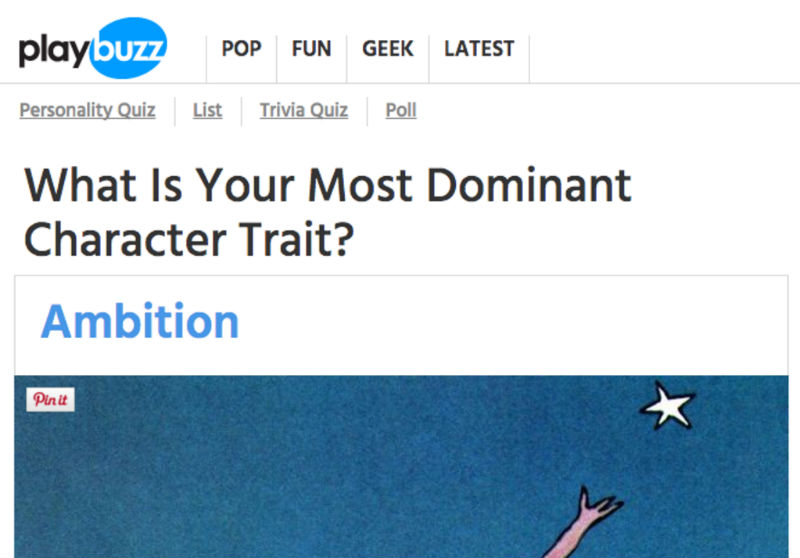
Example: What Is Your Most Dominant Character Trait? (3.9m shares)
This personality quiz was the second most shared post on PlayBuzz this year with almost 4m shares. The top post was another quiz ‘Can We Guess The Level of your Education?‘. PlayBuzz has become a master of the viral quiz, and if you haven’t already studied their viral content, it is definitely worth a look.
playbuzz-quiz

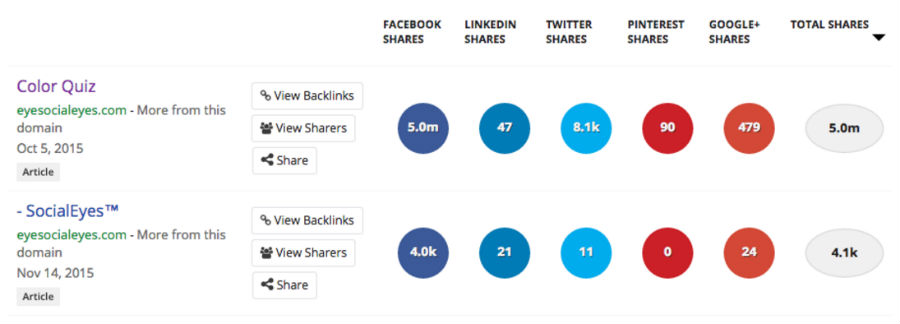
Example: The Color Quiz (5m Shares)
This post was a classic example of viral Facebook content. It drew you in from the very first screen and appealed to your instinct to test yourself. It was also something people wanted to share, as demonstrated by almost 5m shares. Sharing your percentile score (assuming you did ok) also makes it appealing.
colour-quiz
This post exploded on Facebook, and its reach was out of all proportion to shares of other content from the same site as shown below. The site has subsequently run a number of quizzes but created nothing to match the success of this first post. That’s a side lesson–you can’t just re-run what worked and be assured a second viral result. Content formats can get old quickly.
colour-list

Interactive content is a variation on quizzes and can also do very well, as we will see with this next post.
Example: Baby Name Popularity (781,000 shares)
The most shared post on Time this year was on the most popular baby names. You simply enter you name and year of birth, and the site calculates what your name would be now or in other decades based on the popularity of your name when you were born.
baby-names
my-name
This article also made it very easy to share your results with your friends on Facebook or Twitter.
Viral element: Easy-to-take quizzes that highlight something about the user. Interactive content formats and encouragement of sharing.

9) Provide Warnings

The 2014 Marketo and Brian Carter research found that people shared content to provide warnings to other people about dangers such as a scam. This continues to be the case in 2015 as we found a number of most shared posts that were warnings.
Example: Recall Of Kids’ Tylenol (474,000 shares)
The most shared post of Webmd.com this year was a warning about a recall which had four times as many shares as other posts on the site. Interestingly there was other warning content at Webmd, but the Tylenol post was particularly viral.
warning-list
Viral element:  Timely warnings or cautions in your field could win you an audience as it’s helpful content to share.

10) Tell Them The Secrets Of Success

Most people want to be successful. People also like to share content that is valuable or helpful to others. Thus posts designed to help people achieve success have the potential to go viral, if the content delivers.
Example: How Successful People Stay Calm (127,000 shares)
This is our first B2B example, which was one of the top shared posts on LinkedIn this year. It’s had over 3.6m views on LinkedIn.
Based on our look at content that performs well on LinkedIn, it’s clear that the word “successful” in the title helps. This particular title also taps into the current trend and interest in mindfulness.
linkedin-post
linkedin-list
Viral elements: Tips on being successful, practical, helpful content and leveraging the current interest in Mindfulness.

11) Health, Diet & Fitness Tips

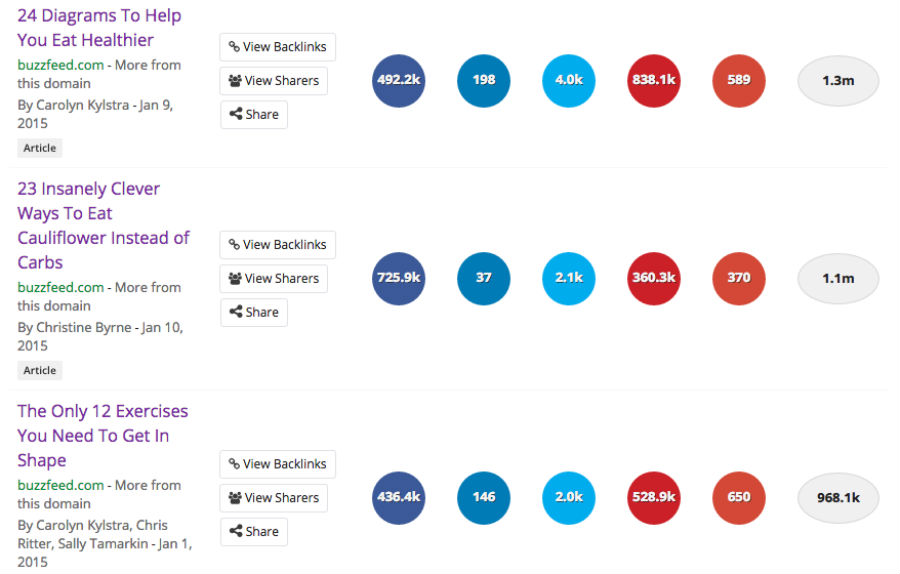
Who doesn’t want to get healthier? Health was a popular topic in 2015. Interestingly, three of the most shared posts on BuzzFeed this year were about health, as seen below.
buzzfeed-health
Example: The Only 12 Exercises You Need (968,000 shares)
This post appealed not only to a desire to be healthy but also to your budget. One noticeable feature was that the post included individual images that were sized and ready for Pinterest. The post was pinned over 500,000 times.
12-exercises
Viral elements: Health, diet and fitness tips. Good use of imagery, a form of picture list post, how-to posts that will help people improve themselves.

12) Tell Them Secrets Of Love & Dating

Love is the drug, as Bryan Ferry put it, and it appears that the right content on love or dating has a lot of potential to go viral.
Example: To Fall In Love With Anyone, Do This. (885,000 shares)
The most shared posts on the New York Times this year are outliers, gaining a lot more shares than other posts, and most of these articles are arguably not news. The second most shared post on the new York Times caught our attention about falling in love.
nytimes-list
The post challenged a common preconception about love, as it says you can can fall in love with anyone–not just your soulmate. This post got significantly more shares than the 3rd and 4th most shared posts on the New York Times and almost double the 5th most shared. It is also a form of “how to” post, and has a great headline that you can’t not love.
ny-post

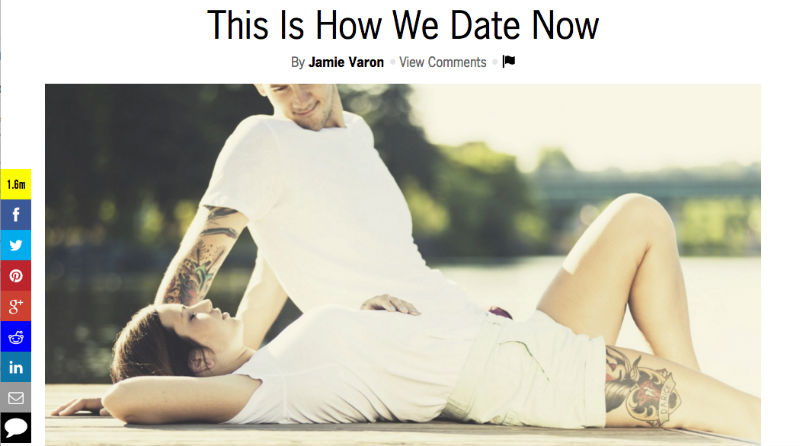
Example: This Is How We Date Now (1.6m shares)
This is a variation on the theme of love and soumates. This post resonated with the audience and was the most shared post on Thoughtcatalog.com this year by some margin with over 1.6m shares.

how-we_date
Viral elements: Insights into love and dating. Great headlines and one was also a ‘how to’ post that had an interesting claim.

13) Share The Secret To A Long Life

The cause of existential angst, according to Sarte, is knowing we are going to die. He also said “hell is other people,” so he probably wasn’t on Facebook. Whether you agree with him or not, it seems we are all keen to find ways to avoid an early grave.
Example: 109-Year Old Woman Says Secret To Long Life Is Avoiding Men (1.9m shares)
This video post was the second most shared article on the Huffington Post this year. In some ways it is an expert interview post as Jessie Gallan has turned 109, but it is also a fun and happy post celebrating long life.
huff-post-old

Jessie puts her long life down to walking, a bowl of porridge each morning, but primarily to avoiding men. However, this may not be the only answer to a long life, as we shall see with our next example below.
Viral elements: Share the secret of eternal life. Or if that’s too much of a stretch, share heartwarming content about longevity. In a way this is a variation on how-to health posts.

14) Share A Heart Warming Story

People love stories and they love to share heart warming stories.
Example: Husband 108, Wife 105, Celebrate 82 Years Married (580,000 shares)
USA Today’s top post this year was a heart warming story of a long and happy marriage. Maybe the moral for men who want to live a long time is to be married.
usa-old-post
usa-list
This post topped USA Today’s most shared content because it was a heartwarming, happy, inspirational story. It may also have some insights for long life as the couple describes their healthy breakfast of tea, oatmeal and fresh fruit. They also nap early and often.
Viral elements: This post contained a happy story of a long marriage and possibly the secrets of a long life.

Conclusions: Four Elements of Shareable Content

Ok, so what have we learnt from the most shared content this year? More importantly can it help us in creating shareable content?
It is worth starting by reiterating that there is no formula for going viral. It’s not always clear what will ignite a post and provoke significant sharing. Even the big sites have random outliers, posts that generate share counts no one could have predicted. The evidence also suggests it is not simply about the content but also about amplification. In our research sharing by just 5 influencers can be enough to ignite content sharing. Paid amplification can also help kick start things if you have a potential viral post.
What we can see from the posts above is that they often combine different elements to make the content more shareable. For example:
  • A quiz on a popular topic leverages both a trend and a shareable content format.
  • A picture list post combines three very shareable elements namely a list, curation and images.
From our analysis there are four different elements that contribute to shareability as follows.
viral-elements
This is not a comprehensive list, just a way of thinking about the elements. A viral post is likely to combine a number of these elements. Nothing guarantees your content will go viral but including one or more of these elements can help make your content more shareable. Thus when creating content you can ask yourself:
  • Does the content have an emotional element?
  • Does the post include shareable content types, such as facts, images, and quotes?
  • Is the topic one that resonates with your audience? Is it trending?
  • Is the format one that works well with your audience, such as practical tips or a quiz?
Headline
Finally, a potential viral or shareable post also needs a good headline. I really like the way BuzzFeed create multiple headlines and A/B test them with audiences. This allows them to tailor based on real audience interaction. However, you may not have this facility.  If not, you can look at the four elements above and think above incorporating these into your headline. For example:
  • Emotional words e.g. Surprising
  • Topic e.g. Zombies
  • Type e.g. Facts
  • Format e.g. List post
Thus a simple headline using all four elements may be “10 surprising facts about Zombies”. Ok, so you can’t just write by numbers like this, but it’s a good way to check that your headline will have shareability.
Can you go viral in 2016?
No promises but..
.. by learning the lessons from this year’s viral content we may be able to make our content more shareable in 2016.
Let us know how you get on. Good luck!

To view the original article Click Here