Showing posts with label psychology. Show all posts

Sunday, 22 November 2015

7 Copywriting Hacks Based in Psychology

Copywriting sometimes feels like one of those elusive skills that only the best of the best professionals truly possess.
They know how and what to write to increase conversions, and seem to have a magic wand they wave over words and turn into gold.
But wouldn’t it be nice if you had a few of their best copywriting hacks up your own sleeve?
Guess what? You can.
In this post, we’ll look at 7 psychology-based copywriting hacks that can get you that much closer to having a copywriting wand of your own.

1. Illusory Truth

The illusory truth effect helps our brain make decisions throughout the day, acting as a shortcut for the decision-making process so that our brains don’t get overloaded.
This psychological tactic gives weight to concepts and ideas that we hear over and over again. Thus, repeated ideas = greater accuracy, more truth.
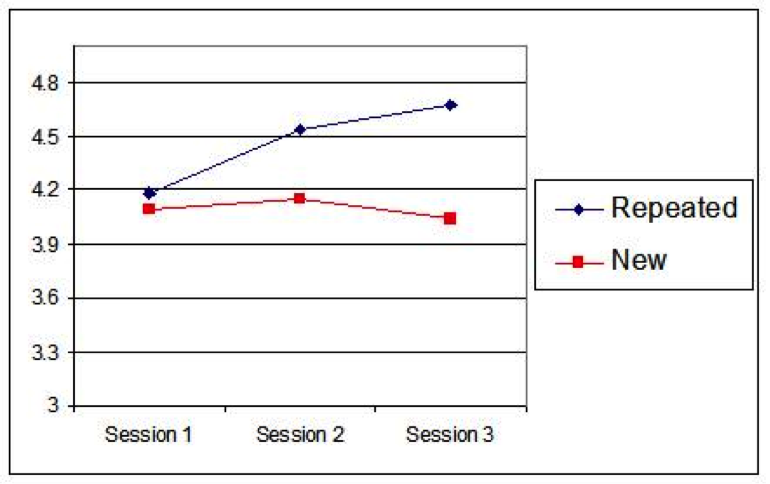
Researchers conducted a survey that asked participants to rate how much they trusted a statement. Some statements were repeated multiple times, while others were stated only once. The study found that people consistently rated the repeated statements as more trustworthy in comparison to statements that were not.
In another study conducted by Hascher, Goldstein, and Toppino, participants saw 60 statements per session, within which 20 statements were repeated. These participants then rated their confidence in each statement on a scale of 1-7, with 1 being the lowest level of confidence, and 7 being the highest. Again, the repeated statements were rated as more trustworthy.
illusory-truth-study

Image Source
The takeaway: You know the old saying from Dale Carnegie, “Tell the audience what you’re going to say, say it; then tell them what you’ve said.” Within your copy, repeat the statements you most want your audience to believe and remember.

2. Rhyming

Rhyming gives copy a fun and quirky air, but who knew it also adds validity?
It’s true: A 2000 study conducted by McGlone and Tofighbakhsh at Lafayette College noted that poetic form impacted people’s perceptions of accuracy—specifically in relation to human behavior.
Here’s an example: When they tested the phrase “What sobriety heals, alcohol reveals” versus “What sobriety conceals, alcohol unmasks”the rhyming version ranked as more accurate than the non-rhyming version.
The psychologists noted their findings indicated rhyme allowed statements to be processed more fluently in the human brain, which is sometimes perceived as truthfulness.
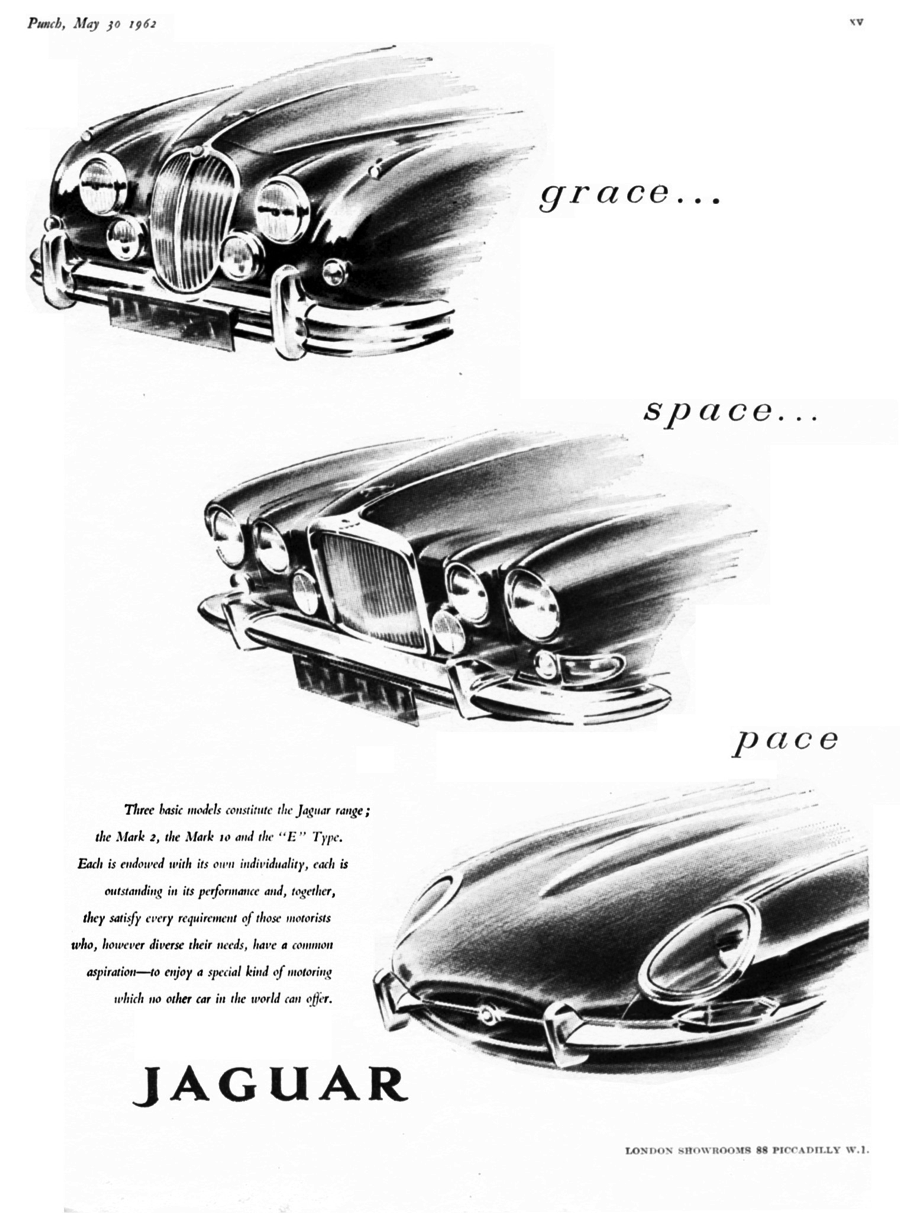
Look at how Jaguar used this tactic in its 1962 ad:
jaguar-1962-advertisement-rhyming

Image Source
The takeaway: The brain readily processes rhyming words and phrases, which sometimes means we view them as more truthful or accurate. Using rhymes in your copy adds a bit of eccentricity to your writing voice and can also make your claims appear more valid.

3. Serial Positioning

Knowing that online readers are scanning the text instead of consuming it word-for-word, we often use bullet points, short paragraphs, and lists to make content more consumable. But where information is placed within that format is something to consider.
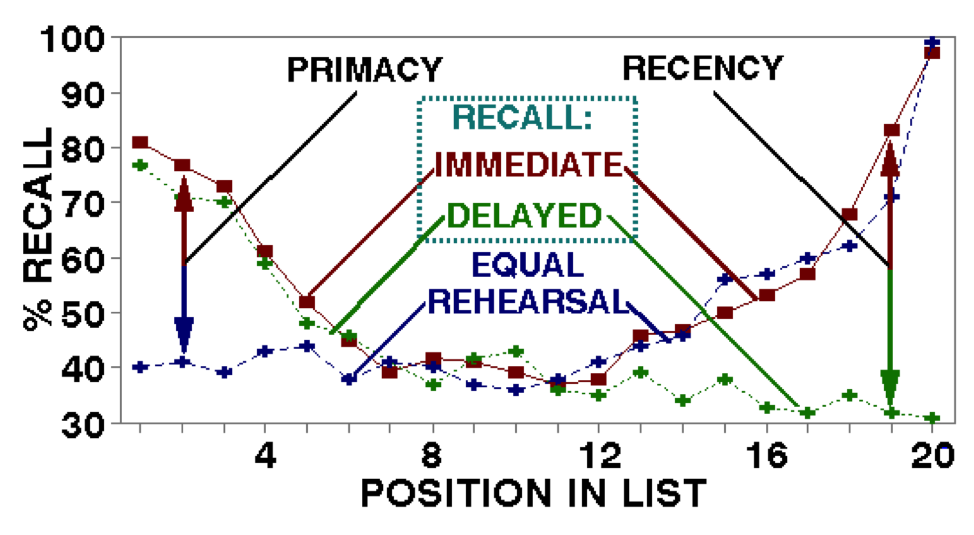
Psychologists that have studied the serial position effect found that when participants hear a list of words and recall them immediately, they have higher accuracy with the words at the beginning and end of a series in comparison to those mid-list. This is known as primacy (for the first few words) and recency (for the words at the end of the list.)
primacy-recency-serial-positioning-study

Image Source
The Takeaway: When writing copy, place the ideas you most care about the reader remembering at the beginning and end of a piece. Within an email context, this means your opening line and closing line are the two most valuable pieces of real estate.

4. Justification

A well-known study from 1978 illustrates the effect of using justification—maybe you’ve heard of it? It’s the Xerox line study.
In the experiment, people waiting in line to use the machine are studied as they react to people asking to jump the line. Those wanting to skip the line asked three different ways:
  1. 1. “Excuse me, I have five pages. May I use the Xerox machine, because I’m in a rush?”
  2. 2. “Excuse me, I have five pages. May I use the Xerox machine?”
  3. 3. “Excuse me, I have five pages. May I use the Xerox machine, because I have to make copies?”
For those who used #1, or “because I’m in a rush?” 94% of people agreed to allow them to do so. At the same time, 93% allowed a person to pass with response #3—which was seemingly devoid of a valid reason. In comparison, however, only 60% agreed to response #2, which lacked the word ‘because.’
Researchers like Ellen Langer of Harvard believe this happens because of mindlessness—which calls upon internal scripts that guide our actions and responses to different scenarios. It’s a sort of an autopilot mode that our brains use to made decisions within social contexts, possibly as an evolutionary survival tool. When we hear a trigger word like ‘because’, it helps us assign credit, blame, or reason, and then respond accordingly (even when the reason isn’t all that valid.)
The Takeaway: Because is a powerful word. When writing persuasive copy, include ‘because’ to reinforce that you have a valid reason for your request—whether it’s to sign up for a free trial, download a template, complete a form, etc.

5. But You Are Free

Reminding your readers that they have the freedom to choose is another strategy based in psychology that’s proven to have powerful persuasive powers. “But you are free” (BYAF) explicitly reminds the reader he or she is free to refuse a request.
Christopher Carpenter at Western Illinois University conducted a worldwide meta-analysis on this topic, which examined 42 different studies on BYAF with more than 22,000 participants.
His findings were dramatic: BYAF doubled the success rate for compliance when employed with participants in a non-sales context. Let me repeat that. Over 22,000 people were studied, and when BYAF was used, conversion rates doubled. DOUBLED! Magic words, don’t you think?
So, for example: Say you’re conducting an online survey. You could use BYAF by writing something like:
We’d be honored if you would share your insights on our 2015 homeowners survey, but you are free to pass on the opportunity as well.
The Takeaway: Remind your readers that they have the freedom to make a choice—no one is forcing them to act. This simple reminder goes a long, long way.

6. Leverage your P.S. Line

Remember how we talked about primacy and recency earlier? Well, using a P.S. line in your copy is another way you can tap into that recency effect.
Because it’s literally post-script, it’s the last message a reader sees upon reaching the bottom of the page—so we know it’s going to stand out.
Fundraising organizations have been using the P.S. tactic for years.
But, whyRay Jutkins, a direct mail copywriter, noted that 79% of donors and prospects that open direct mail read the postscript first.
buffer-email-ps-line

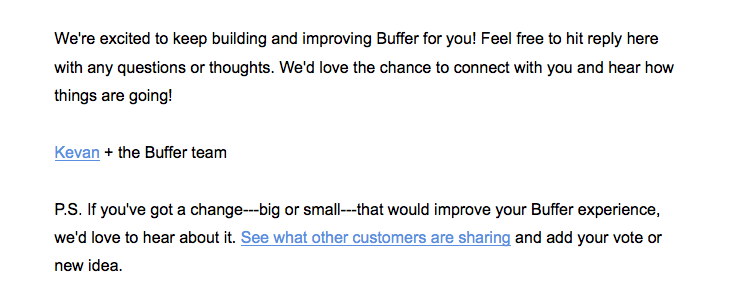
This P.S. line includes a relevant CTA and encourages the reader to reply or offer feedback in another way–showing the company values the opinions of its users.
It seems we’ve come to understand the P.S. line as the most essential or important piece of long-form content, which is why a P.S. line is the place you should put your main call to action. For many, it’s the first (or only) place the eye goes when reading.
The Takeaway: When writing long-form content (like email, blog posts, direct mail, etc.) use a P.S. line to reinforce your main CTA.

7. Textural Adjectives

Krish Sathian at Emory University has conducted multiple studies on how textural adjectives activate the brain in a unique way. He’s found that using textural metaphors—things like “Having a rough day?” vs. “Having a bad day?” activated the brain’s sensory areas in very different ways.
fMRI data collected from those who were surveyed showed that activity jumped in the somatosensory cortex when a textural metaphor was used—but was quiet when literal meanings were used in their place.
There is still research to be done on how this brain activity directly relates to persuasion, but increased brain activity has been linked to memory and increased recall.
The Takeaway: Your copy should make good use of textural adjectives in place of commonly used colloquialisms. Think about how you can surprise your readers by inserting a texture-based word where they’re expecting a more bland, texture-less substitute.

Using Research for Smarter, More Effective Copy

Thanks to the psychology-based research each of these 7 copywriting hacks taps into, you can create more effective, conversion-oriented copy.
Don’t reinvent the wheel—look to the studies that have already shed light on what works and what doesn’t in terms of persuasion, memory, and conversion.

Who knows? You may find that doing something as simple as inserting a single word will dramatically increase the success of your written content.
To view the original article Click Here

Friday, 30 October 2015

5 Psychology Tips to Improve Your Social Media Posts

Are you struggling to create social media engagement?
Do you want tips to improve your posts?
To get more social media engagement, you need to tailor your content to appeal to your audience on an emotional level.
In this article you’ll discover five psychology tips to improve engagement on your social media posts.
psychology tips to improve social media posts
Discover five psychology tips to improve your social media posts.

#1: Images Speak to Viewers

Your image is your first call to action in your social posts. It’s the front door to your content, so it needs to make an impact.
It’s important to choose an image that expresses what you’re trying to say in your post. For example, Red Bull’s Instagram images inspire their followers to enjoy life and seek new adventures.
red bull instagram post
For your social posts, choose images that tell a story.
Good social images also stand out from the crowd and command attention in people’s news feeds. The image in this Coca-Cola post draws the audience’s attention with its use of vivid colors and an interesting pattern.
coca-cola facebook post
Select images that will draw your audience’s attention.
Your images should also be relevant to your target audience. In this Facebook post, Zappos uses an image that appeals to their audience: women who are fashion-conscious and love to buy shoes.
zappos facebook post
Look for images that will appeal to your target audience.

#2: Color Communicates

Brands that make the best color choices are the brands that get the most engagement on social media.
Before you start sharing your content on social media, you should choose a color that is synonymous with your brand. Your color choice not only represents your business but also impacts your followers on a psychological level.
Rob Russo’s visual branding stands out in his followers’ news feeds and draws attention to what he’s saying. That’s the strategy you want to apply to your visual marketing.
rob russo image tweet
The right brand colors can make your posts stand out in people’s news feeds.
The Honest Company’s signature color is used prominently on all of their social channels and in their posts. The color makes their posts instantly recognizable to their fans.
the honest compmany image tweet
Use your brand colors in your social posts.
Think about whether your brand color speaks to your target market. If you’re using a consistent color for your brand but not getting the engagement you want, you may need to rethink your color choice.

#3: Words Trigger Action

After creating your first call to action with an image, it’s time to focus on the description.
The law of attraction states that “like attracts like,” so start your description with words you know people want or like to hear. Six words that typically work well are who, what, when, where, why and how. These words spark an emotional response that grabs a person’s attention.
You can also try these trigger words to engage your audience.

#4: Emotion Connects

Connecting with readers on an emotional level, especially when it’s something happy, can impact your social media posts.
In this Facebook post, Adidas connects with their fans by sharing Flavia Pennetta’s exhilaration at winning her first Grand Slam singles title.
adidas facebook post
Connect with your audience on an emotional level with your posts.
Whether you know it or not, you’re prompting some sort of emotion with all of your social posts. Even if it’s boredom, readers are feeling an emotion when they see your post.
To make the most of this opportunity, share good things with your followers. Portray a friendlyhappy brand that is helpful and generous, and people will be drawn to your posts.
On Oreo’s Facebook page, their posts project a fun and lighthearted personality.
oreo facebook post
Oreo projects an upbeat, friendly vibe with their Facebook posts.

#5: Conversation Engages

How you introduce conversation into the mix of your social media posts helps determine how much people will open up to you.
The easiest, most effective way to spark communication is to ask for it. You mightbegin your post with a question or end with a question or a statement that prompts people to engage.
In this post, Threadless engages their followers by asking them to submit a quip to use in one of their t-shirt designs.
threadless facebook post
Engage your followers by asking them a question.
By establishing communication with your followers, you’ll discover what they need and want and how you can give it to them.
In the post below, Livescribe asks their followers to share stories about how the company’s products have helped them in personal or professional capacities. These stories provide the company great insight into the many ways customers use their products.
livescribe facebook post
Sparking a conversation allows you and your followers to get to know each other a little better.
Effective communication allows you to make a positive impact with your social posts. Here, Popchips engages their Facebook followers by asking them to share pictures of their dogs to celebrate National Puppy Day.
popchips facebook post
Invite followers to share something they enjoy.
Your followers will remember their positive conversation with your brand the next time they see you in their news stream.
Remember that when you start giving people a glimpse of your brand’s personality, they’ll begin to trust you.
Choose a Friendly Profile Image
Your personal profile picture can also have an impact on your social media posts. If you appear friendly and helpful in your profile photo, you’re likely to attract and draw in more followers.
This psychological study suggests that you smile in your photoshow your eyes (no sunglasses) and squinch (like a squint, but a bit less). Also, crop the photo to show you from your shoulders upward or from your head to waist.
Conclusion
Think carefully about each element of your social media posts, including the images, your use of brand colors and the description. These tips will help you connect with your followers on an emotional level and create a conversation.
What do you think? Have you tried any of these tactics to improve your social media posts? What techniques do you use to appeal to followers on your social channels? 
Please share your thoughts in the comments below.
To view the original article Click Here

Wednesday, 7 October 2015

6 Secrets About the Human Brain That Will Make You a Better Marketer

6 Secrets About the Human Brain That Will Make You a Better Marketer
Knowing how the human mind processes information and images—and putting that knowledge to use—can help you become a more engaging and effective marketer.
Researchers in a new(ish) field of study are trying to figure out how our hard-wired preferences affect the decisions we make. Neuromarketing research is “the systematic collection and interpretation of neurological and neurophysiological insights about individuals using different protocols, allowing researchers to explore nonverbal and unconscious physiological responses to various stimuli for the purposes of market research,” according to the Neuromarketing Science & Business Association.
Put simply, neuromarketing is the study of how our brains respond to marketing and how it affects our behavior—consciously or unconsciously—explains Andy Crestodina, co-founder and strategic director of Chicago web design and development agency Orbit Media Studios, who speaks and writes about the topic.
“There are ‘cognitive biases’ built into all of us,” he says. “We can’t help it. Marketing either works with or against the cognitive biases.”
It’s critical to understand these predispositions, to know how our minds process information and images. “The competition for attention is fierce, so knowing what lights up our brains gives marketers an edge that can help them win,” says Grey Garner, vice president of marketing at Emma, an email marketing provider based in Nashville, Tenn.
So let’s take a look at some secrets of the human mind you can tap into from a marketing perspective.
Secret 1: We all have a primitive brain. The amygdala controls our reactions and emotions, and it works much faster than our conscious, rational mind, Garner says. In fact, we experience gut reactions in three seconds or less. Emotions make a more lasting imprint than rational thought.
Marketing takeaway: Aim for a gut reaction, and pay special attention to how your materials look when scanned quickly (as opposed to deliberately considered—because no one has the time or inclination to do that anymore).
Pay attention to the things people see first. In email marketing, your subject line and pre-header (that bit of text you read most prominently on a mobile device, above the body of the email) should grab readers and speak to their pains, wants, needs and emotions. In blogging or other online content, pay special attention to headlines. (You should spend as much time writing the headline as you do the rest of the piece.) In website content, make your pages welcoming and easily grokked.
Secret 2: Our brains love images. Our brains process images much faster than text. Approximately 90 percent of all data that the brain processes is visual. We remember pictures with text more than we remember text alone.
Marketing takeaway: Use images, of course—but make them special, and lay off the stock shots. I like the way Loews Hotels & Resorts integrates candid guest images into its “Travel for Real” ad campaign, and the way men’s clothing company Chubbies uses hilarious GIFs in its email mailings. You can also use a web tool like Canva or mobile app Over (madewithover.com) to create custom images.
Secret 3: Our brains love images of faces. Research suggests that natural selection favored humans who were able to quickly identify threats and build relationships. As part of that, we are wired from birth to recognize and prefer human faces. The part of the brain that processes human faces is right next to the part that processes emotions.
Marketing takeaway: Use real people in your marketing materials, and consider putting faces on landing pages, in emails or on web pages designed to drive a desired action.
Eye-tracking studies show that our brains will default to first look at human faces on a web page. What’s more, we’ll look where the faces are looking. So entice by adding, say, a photo of a face that looks toward a call-to-action button or crucial bit of text.
Secret 4: Colors inspire specific feelings. There’s more to color choice than what looks good. Different colors cue different signals in a brain. In fact, research has shown that 62 to 90 percent of our feeling about a product is determined by color alone. Yellow activates the anxiety center of the brain. Blue builds trust. Red creates urgency. And that’s just the start.
Marketing takeaway: There’s a science and art behind color choice—especially as it relates to marketing fundamentals like call-to-action buttons. “Don’t choose colors arbitrarily,” Crestodina says.
What colors work best for your company will depend on your brand, positioning and audience. The best approach, as always, is to test how color affects response before choosing.
Secret 5: Names change behavior. What something is called affects our reaction to it. A recent study by David R. Just and Brian Wansink of the Cornell University Food and Brand Lab found that calling the same portion of spaghetti “double-size” instead of “regular” caused diners to eat less.
Marketing takeaway: Carefully consider how your wording might influence attitude as you name products, describe models or options and create customer messaging.
Secret 6: We crave belonging. We have an innate desire to conform. “When people are free to do as they please, they usually imitate each other,” said philosopher Eric Hoffer.
Marketing takeaway: Remove anxiety, signal belonging and build credibility with an audience by using social proof and signals—in the form of endorsements from well-known influencers in your market; badges or awards from McAfee, TRUSTe or Norton; media logos (from outlets that have quoted or referenced you); customer testimonials woven throughout a site (not exiled to a specific page); and social widgets and shares, assuming you have a solid social media program in place.
One more tip is to use inclusive, specific language on any call to action to signal what Crestodina calls a “call to conform.” Rather than having a sign-up box for a newsletter, say something like, “We are the nation’s leading resource for home heating and cooling information and supplies. Subscribe now.” You might invoke belonging by saying: “Join more than 35,000 contractors and homeowners who seek weekly heating and cooling tips and supplies.”
To view the original article Click Here

Sunday, 30 August 2015

Inside the Science and Psychology of Shareable Content

What makes you stop scrolling through an article, open up a social media app and hit the share button?
Is it logic, emotion, or something else?
Turns out, there’s more to social sharing than just measuring metrics:Psychology.
The strange nature of our brains is the reason we hotly debate the color of a dressor why we freely and emotionally share a post by a grieving widow after the death of her husband or why we feel an urgent need to pass on that video of the ice-cream eating dog to our animal-loving father-in-law. (Guilty!)
It’s not logic that guides those shares; it’s emotion. How else can you explain 8.2 million hits to a YouTube music video that a majority of people claim to have not liked?
If you want your content to be shared and shared regularly, understanding the “why” and “how” behind social shares can go a long way in showing you how tocraft the perfect post for your audience. In order to do so, you might want to:
  1. Understand why people share content
  2. Know what kind of content they’re more likely to share
  3. Set about the task of creating content that satisfies those emotions
We’ve put together a few handy tips on how to understand what your audience wants and start the process of delivering it to them.
pablo (1)

5 Reasons Why People Share to Social Media

1. Neuroscience: We share to entertain, inspire, and be useful

Even though social media does have a tendency of having people focus on themselves, the primary reason that people share things on their Facebook pages or Twitter feeds, research shows, is to be useful to others.
In a 2013 study conducted by psychologists at UCLA, the researchers were, for the first time, able to determine which brain regions are associated with ideas that become contagious and which regions are associated with being an effective communicator of ideas.
NYT study -1
The TPJ or the temporoparietal junction is this area of the brain that lit up during functional magnetic resonance imagine (fMRI) brain scans when people were first exposed to new ideas that they would later recommend.
Matthew Lieberman, a UCLA professor of psychology and of psychiatry and biobehavioral sciences and author of the book Social: Why Our Brains are Wired to Connect, noted:
Our study suggests that people are regularly attuned to how the things they’re seeing will be useful and interesting, not just to themselves, but also to other people. We always seem to be on the lookout for who else will find thishelpful, amusing or interesting, and our brain data are showing evidence of that. At the first encounter with information, people are already using the brain network involved in thinking about how this can be interesting to other people. We’re wired to want to share information with other people. I think that is a profound statement about the social nature of our minds.

2. Psychology: We share to express who we really are

In 1986, psychologists Hazel Markus and Paula Nurius recognized that there is a disparity between our “now self” and our “possible self.”
In a paper they published at the time, they developed the concept of our possible selves:
  1. the ideal selves that we would like to become
  2. the selves that we could become, and
  3. the selves that we are afraid of becoming
This first self, the idealized version of ourselves is what we frequently tend to share on social media.
Whether or not this representation of our possible self is realistic or not is irrelevant, researchers note. The point is that we’re picturing in our minds this possible self that we are or may someday be and sharing information that fits in with this notion of who we are.
When we share in this mode, sometimes what we’re sharing is a sense of our ideal self and who we aspire to be. This is why some people share political commentary, outrage over particular issues, and success stories of people who they hope they can be like someday.
As the authors themselves so eloquently note:
Possible selves contribute to the fluidity or malleability of the self because they are differentially activated by the social situation and determine the nature of the working self-concept. At the same time, the individual’s hopes and fears, goals and threats, and the cognitive structures that carry the are defining features of the self-concept: these features provide some of the most compelling evidence of continuity of identity across time.

3. Community: To nurture our relationships

Whenever I see a funny comic about procrastination, I share it with my closest friend, a proud procrastinator. Whenever I see a funny dog video, I send it straight to my father-in-law, the animal lover.
Every time I see any of these things, I feel an immediate connection to those people. I think of them and feel the urge to share what I’ve found with them.
I’m not alone.
In a study undertaken by The New York Times Customer Insight Group in conjunction with Latitude Research titled “The Psychology of Sharing: Why Do People Share Online?” 78% of respondents said that they shared information online because it let them stay connected to people they may not otherwise stay in touch with.
Further, 73% of them said they shared information because it allowed them to connect with others who shared their interests.
NYT study - 2

4. Motivation: To feel more involved

In my days of daily journalism, an editor at a local newspaper once told me his fix for a slow news day.
Dogs and babies.
“They’re cute,” he would say. “They pull at your heartstrings. No one can resist a cuddly dog or a cute baby. Preferably both together.”
The medium may have changed but the message hasn’t. People still love cuddly dogs, cute babies, preferably both together.
In fact, as far back as fifty years ago, studies were being undertaken to see why people talked about brands and coming to the same conclusions that we are today. In 1966, in a study reported on by the Harvard Business Review, the researcher Earnest Dichter found that 64% of sharing is about the sharer themselves.
He noted that there were four motivations for a person to communicate about a brand.
  1. The first (about 33% of the time) was because of product-involvement, that isthe experience was so good, unique, or new that it had to be shared.
  2. The second (about 24%) was self-involvement, that is, to gain attention byshowing people that you were part of an exclusive club of buyers or had inside information.
  3. The third (around 20%) was other-involvement, that is wanting to help out and express caring or friendship.
  4. And finally, the fourth (also around 20%) was message-involvement, that is,the message was so wonderful or funny or brilliant that it deserved to be shared.
sharing-motivations

5. Altruism: To get the word out about specific causes

In the New York Times Customer Insight Group report, 84% of respondents said they share because “it is a way to support causes or issues they care about.”
In fact, the report further goes to show that 85% of people say reading other people’s responses helps them understand and process information and events. So not only do we share information about the causes that are dear to us, but we respond to causes that are dear to other people if they take the time to share that information with us through social media.
Remember the ALS Ice Bucket challenge?

What People Share and How to Make Your Content Go Viral

In a research study titled “Why Content Goes Viral,” assistant professor of marketing at the Wharton School of Business Jonah Berger (who you may also know as the author of the book Contagious) and co-author Katy Milkman looked at 7,000 articles published at The New York Times to see which ones got the most views and social shares and why. The goal of the study was to document what makes content go viral and how to replicate those findings to create viral content.
This infographic from CoSchedule does a great job capturing some of the findings of the study:
Blog_Garrett_PyschSharing_Infograph2
The researchers from the study came up with three key ideas based on their findings:

1. Positive content trumps negativity

You may not know it from your Facebook feed, but Berger and Milkman found that positive content and stories were far more likely to be shared and to go viral than negative news stories.
Are you surprised by this finding? Most people are. But the reason bad news sticks in our minds more than good news is because of our brain’s “negativity bias.” Human brains are wired to react with greater sensitivity to bad news and feedback than anything positive, and so you may see and hear a hundred pieces of positive news throughout your day but remember that one news story about a sick child. It also explains why you remember an insult or attack decades after all the compliments and accolades have been forgotten.
Yet, research shows that if you want your content to go viral and reach more people, it has more of a likelihood of doing so if it comes in a positive package.
How to create positive content
Try framing events in a positive context. Research shows that superlatives can be super effective in headlines. For example:
  • Best
  • Biggest
  • Greatest
As Courtney explains in this post, Buffer’s focus on positivity and happinessmeans that we turn this technique inside out with posts such as 10 Things To Stop Doing Today to Be Happier, Backed by Science.

2. Content that evokes high arousal emotions does better

This is probably not quite as surprisingly, but Berger and Milkman found that the more a piece of content could evoke a high-arousal emotion such as awe, anger, anxiety, fear, sadness, humor, or wonder, the better its chances of being shared repeatedly and going viral.
That’s why counter-intuitive takes on issues do so well and why articles that make you angry are often the ones that you forward to friends.
In fact, this is backed up by our own research here at Buffer. In a recent experiment, we found that one of the key things that makes images go viral is an element of surprise.
In the NYT study, the articles that scored highly on different dimensions were:
Emotionality:
  • Redefining Depression as Mere Sadness
  • When All Else Fails, Blaming the Patient Often Comes Next
Positivity:
  • Wide-Eyed New Arrivals Falling in Love with the City
  • Tony Award for Philanthropy
(Low-scoring)
  • Web Rumors Tied to Korean Actress’s Suicide
  • Germany: Baby Polar Bear’s Feeder Dies
Awe:
  • Rare Treatment Is Reported to Cure AIDS Patient
  • The Promise and Power of RNA
Anger:
  • What Red Ink? Wall Street Paid Hefty Bonuses
  • Loan Titans Paid McCain Adviser Nearly $2 Million
Anxiety
  • For Stocks, Worst Single-Day Drop in Two Decades
  • Home Prices Seem Far From Bottom
Sadness
  • Maimed on 9/11, Trying to Be Whole Again
  • Obama Pays Tribute to His Grandmother After She Dies
How to create emotional content
One of the driving forces for emotional content is someone’s first touch with your content: the headline.
There are some amazingly useful tools out there to help ensure your headline packs the right emotional punch.
  • CoSchedule Headline Analyzer – This fantastic tool will quickly tell you how to improve your headlines by scoring you on your word choices. It takes a look at the words in your headline and sorts them into four categories: common, uncommon, emotional, and power. The more emotional and power words, the better your headline.
  • Advanced Marketing Institute Headline Analyzer – This free tool analyzes your headlines to determine the Emotional Marketing Value (EMV) score of your headline. The tool analyzes the total number of EMV words in relation to the total number of words in the headline and comes up with a score.
Coschedule

3. Practical and useful information wins out every time

Finally, no surprise to anyone who has read and shared our own content here at Buffer (thank you, by the way!), content that helps you solve a problem, gives you actionable tips, and shows you practical strategies for living your life is destined for success as long as it can meet the needs of a large number of people and do it in a unique and interesting way.
How to create practical, useful content
In her article Transforming Content From Lifeless to Actionable, blogger Amanda Gallucci offers the following tips on how to do this effectively. She writes:
  1. Involve your audience: This might involve comments, surveys, or questions, but most importantly, referencing your audience in the content itself. Gallucci suggests creating interactive modules that readers can use within the content itself.
  2. Link your research to applications: Research and numbers are great, but showing how users can apply that research to their lives or solving their problems can be a great way of providing value.
  3. Look beyond your industry: When it comes to inspiration, don’t let your industry experts be the only thing that guides you towards creating useful content that is a match for your audience. If your business focuses on finances and numbers, considering learning from creative businesses, and vice versa.
  4. State the intended outcome early on: Whenever you’re creating a piece of content, it’s always a good idea to state, right upfront, what the visitor or reader will get if he or she reaches the end of the article. Make a promise to your reader to teach or educate them, and then keep it.
  5. Think ahead: One of the best things you can do for your content is to have an editorial calendar that guides your day-to-day content decisions and gives you the flexibility and room to comment on industry-specific events and anniversaries and give readers an analysis of any big news that comes up in your space.
So there you have it. Be positive, touch on some emotions, and be useful. The three keys to creating content that gets shared again and again. And again.

Over To You

I’d love to hear from you about your experiences with viral content. Have you ever had anything go massively viral? What did you learn from the experience?
To view the original article Click Here